The 45-to-70-liter capacity segment commanded a 41.6% share of the Automotive Fuel Tank Market in 2025.
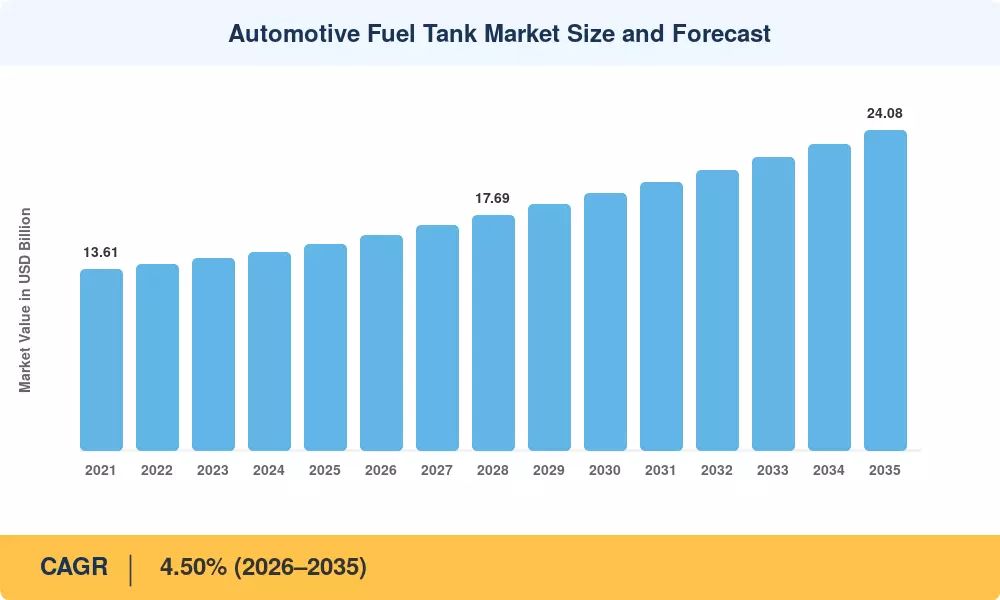
NEW YORK, NY, UNITED STATES, August 26, 2026 /EINPresswire.com/ — According to Market Research Future, the Automotive Fuel Tank Market is projected to reach USD 24.08 billion by 2035, registering a CAGR of 4.50% during the forecast period (2026–2035). This steady growth trajectory underscores the continued relevance of fuel storage systems in the global automotive industry, even as the sector undergoes a transformative shift toward electrification. The market’s resilience is driven by sustained demand for internal combustion engine vehicles in developing regions, technological innovations in lightweight materials, and the expanding commercial vehicle segment that requires robust, high-capacity fuel storage solutions.
Market Overview
Automotive fuel tanks serve as the primary storage receptacles for combustible fuels in internal combustion engine vehicles, playing a critical role in vehicle safety, performance, and efficiency. These tanks are engineered to withstand rigorous operating conditions while ensuring secure fuel containment, proper venting, and reliable delivery to the engine. The market encompasses a diverse range of products varying by material composition, capacity, and vehicle application, catering to passenger cars, light commercial vehicles, and medium and heavy commercial vehicles.
The key growth drivers propelling this market forward include the robust growth in automotive production and sales, particularly in emerging economies where rising disposable incomes and urbanization are fueling vehicle demand. The global vehicle parc continues to expand, with new vehicle sales expected to exceed 100 million units annually, directly driving demand for fuel tanks. Additionally, stringent emission regulations worldwide are compelling manufacturers to develop advanced fuel tank solutions that minimize evaporative emissions and enhance fuel efficiency. The shift from traditional steel tanks to lightweight plastic and aluminum alternatives is gaining momentum, as automotive manufacturers seek to reduce overall vehicle weight to meet Corporate Average Fuel Economy standards.
Technological developments are reshaping the automotive fuel tank landscape through continuous innovation. High-Density Polyethylene (HDPE) has emerged as the dominant material for fuel tank manufacturing, accounting for a significant market share due to its lightweight properties, corrosion resistance, and design flexibility. Multi-layered plastic tanks with barrier technologies are being developed to reduce fuel permeation and meet increasingly stringent environmental regulations. Manufacturers are also investing in advanced manufacturing techniques such as blow-molding and 3D molding, enabling complex shapes that optimize space utilization within vehicle architectures. Smart fuel tank systems incorporating sensors for fuel level, pressure, and temperature monitoring are gaining traction, aligning with the broader trend of vehicle digitization and connected car technologies.
📍 Get Free Sample Report for Detailed Market Insights:
https://www.marketresearchfuture.com/sample_request/5568
Market Segmentation
The automotive fuel tank market is segmented based on capacity, material type, vehicle type, fuel type, and regional analysis to provide comprehensive insights into industry dynamics.
By Capacity: The market is categorized into Less Than 45 Liter, 45 to 70 Liter, and Above 70 Liter segments. The Less Than 45 Liter segment dominates the market, driven by widespread installation in passenger cars, particularly hatchbacks and sedans that dominate urban markets. Rising urbanization, improving living standards, and growing interest in lightweight, fuel-efficient vehicles among younger consumers are driving this segment’s growth. The 45 to 70 Liter capacity segment represents a significant portion of the market, catering to mid-size sedans, SUVs, and light commercial vehicles. Above 70 Liter capacity tanks are primarily used in large SUVs, pickup trucks, and heavy commercial vehicles, with growing popularity in markets like North America where large vehicles dominate consumer preferences.
By Material Type: The market is segmented into Plastic (HDPE), Steel, Aluminum, and Composite materials. Plastic tanks, manufactured using High-Density Polyethylene, dominate the market with approximately 80 to 85% share, preferred for their weight reduction benefits, corrosion resistance, design flexibility, and lower manufacturing costs compared to metal alternatives. Aluminum tanks are gaining traction, particularly in premium and performance vehicles, as they offer excellent weight reduction properties while maintaining structural integrity. The use of aluminum contributes to improved fuel efficiency by reducing overall vehicle weight, with every 100 kg reduction potentially saving 0.3 to 0.5 liters of fuel per 100 kilometers driven. Steel tanks, while durable, are experiencing declining demand due to weight and corrosion concerns.
By Vehicle Type: The market is divided into Passenger Cars, Light Commercial Vehicles, and Medium and Heavy Commercial Vehicles. Passenger cars constitute the largest segment, accounting for approximately 70% of market revenue, driven by high production volumes and consumer demand for efficient, lightweight fuel storage solutions. Rising urbanization, increasing disposable incomes, and growing consumer preference for new, technologically advanced vehicles are driving this segment’s growth. Light commercial vehicles, including vans, pickup trucks, and small delivery vehicles, represent a growing segment as e-commerce expansion and last-mile delivery services increase demand for durable, reliable fuel storage solutions. Medium and heavy commercial vehicles, including long-haul trucks, buses, and construction vehicles, require large-capacity, robust tanks capable of withstanding demanding operating conditions, with growth tied to logistics industry expansion and infrastructure development.
By Fuel Type: The market segments include Gasoline, Diesel, CNG/LPG, and Hydrogen. Gasoline and diesel remain the dominant fuel types, with gasoline particularly prevalent in passenger cars and diesel widely used in commercial vehicles. CNG and LPG vehicles are gaining traction in regions like Asia Pacific, creating demand for specialized high-pressure fuel tanks capable of safely storing these alternative fuels. Hydrogen vehicles, while currently a small segment, represent a growing opportunity as governments and manufacturers invest in hydrogen mobility infrastructure, with specialized hydrogen storage tanks requiring advanced materials and manufacturing techniques to handle high-pressure storage conditions.
By Region: The market covers North America, Europe, South America, Asia Pacific, and the Middle East and Africa. Asia Pacific dominates the global market with approximately 55% share, driven by massive automotive manufacturing volumes in China, India, Japan, and South Korea, coupled with rising disposable incomes, rapid urbanization, and growing vehicle production. North America follows as a significant market driven by high consumer demand for large vehicles like pickup trucks and SUVs, strict emission regulations, and robust infrastructure development. Europe represents a mature market with strong regulatory frameworks, while South America and the Middle East and Africa represent emerging regions with growth potential.
🛒 You can buy this market report at:
https://www.marketresearchfuture.com/checkout?currency=one_user-USD&report_id=5568
Regional Analysis
Asia Pacific leads the global automotive fuel tank market, commanding an estimated 55% share during the forecast period, driven by massive vehicle production volumes, a growing middle class, and increasing adoption of advanced automotive technologies. China dominates the regional market, with local and international companies building massive manufacturing facilities to serve the country’s burgeoning automotive industry. China is also investing heavily in hydrogen mobility, creating demand for high-pressure hydrogen storage vessels. In January 2025, Plastic Omnium, through its joint venture, broke ground on a Shanghai-based high-pressure hydrogen vessel mega-plant capable of producing up to 60,000 hydrogen vessels annually, scheduled for operation in 2026. India represents a dynamic market undergoing transformation, with government and industry promoting cleaner vehicle technologies including hybrids and alternative fuels. In March 2025, Jio-bp, a joint venture between Reliance and bp, showcased innovative split-fuel tank technology in Mumbai, demonstrating the region’s focus on advanced fuel storage solutions. Japan and South Korea continue as significant markets with mature automotive manufacturing bases and sophisticated fuel tank technologies. The Asia Pacific Automotive Fuel Filter Market also benefits from this regional automotive dominance, as filter demand parallels vehicle production and fuel system requirements.
North America represents a substantial market, expected to grow at a steady CAGR driven by robust regulatory frameworks and high consumer demand for large vehicles such as pickup trucks and SUVs that require larger fuel tanks. The United States dominates the North American market, with consumers showing strong preference for vehicles with extended driving range. The region’s mature automotive market is rapidly transitioning toward electrification while simultaneously improving capabilities in traditional combustion and fuel storage technologies. Government mandates for zero-emission vehicle sales are reshaping the landscape, with Canada targeting 100% zero-emission passenger car sales by 2035, with interim targets of 20% by 2026 and 60% by 2030. These mandates are driving innovation in fuel systems for hybrid vehicles and alternative fuel storage. The U.S. market sees steady demand for fuel tanks in trucks and SUVs, though passenger car tank demand faces challenges from EV adoption.
Europe represents a market undergoing profound transformation driven by the region’s bold push for alternative fuels and the circular economy. Component suppliers are at the forefront of creating innovation, developing cutting-edge fuel systems for a wide range of non-fossil fuels to help automakers achieve bold decarbonization strategies. Germany leads the region, with the federal government actively amending national law to introduce new fuel types and infrastructure. In March 2025, the German government tabled a new ordinance to implement EU law on fuel quality, officially introducing B10 diesel to the German market with standardized labeling requirements. The UK market is characterized by strategic consolidations, leading to more powerful and diversified Tier 1 suppliers. TI Automotive marked its European debut at IAA Mobility 2025, presenting an extensive product range reflecting the industry trend toward integrated, holistic solutions. The European automotive fuel tank market faces challenges from stringent emissions targets and increasing EV adoption, though the region’s strong automotive production base, with 12.1 million units produced in 2023, continues to support fuel tank demand.
South America and the Middle East and Africa represent developing markets with significant growth potential. In Latin America, large improvements in auto production are envisaged in key markets like Brazil and Mexico. Brazil’s auto production increased 6.8% to 2.75 million units in 2025, signaling industry strengthening and subsequent fuel tank demand growth. Mexico, an important vehicle manufacturing hub, produced 351,535 light vehicles in November 2024, up 6.7% year-over-year, driving fuel tank demand. In the Middle East, Saudi Arabia represents a major automotive market with approximately 8 million passenger cars on the road and at least 650,000 new vehicles annually, sustaining substantial fuel tank demand. The country’s focus on expanding infrastructure and urbanization further supports demand for automotive fuel tanks. These regions present opportunities for fuel tank suppliers as vehicle fleets continue to expand.
Competitive Landscape and Key Players
The automotive fuel tank market is highly competitive and moderately consolidated, with key players focusing on partnerships, regional expansions, technological innovation, and product portfolio enhancement to strengthen their market positions. Major companies operating in this space include Plastic Omnium Group, Kautex Textron GmbH & Co. KG, YAPP Automotive Parts Co., Ltd., TI Automotive Inc., Magna International Inc., Unipres Corporation, Continental AG, LyondellBasell, Yachiyo Industry Co., Ltd., Allgaier Automotive, Boyd Welding, Martinrea International Inc., POSCO Co., Ltd., and Baosteel Group Corporation.
Plastic Omnium, a French company, stands as a market leader in plastic tank innovation, investing significantly in research and development to create advanced fuel storage solutions. The company’s recent investments in hydrogen storage manufacturing capacity in China demonstrate its commitment to next-generation fuel storage technologies. YAPP Automotive, ranking third globally and first in China, sold 9.7 million tanks in 2024, serving major automakers including Volkswagen, Toyota, and BYD. Kautex Textron GmbH & Co. KG, a German player, specializes in fuel systems and continues to innovate in multi-layered tank technologies that reduce fuel permeation and meet stringent emissions standards. TI Automotive Inc., a UK-based company, focuses on fluid management and has marked its European expansion with significant product presentations at major industry events.
Strategic developments are reshaping the competitive landscape. Leading market companies are extensively investing in R&D to expand product lines, driving market growth through new product releases, contractual agreements, mergers and acquisitions, and strategic collaborations. Manufacturers are focusing on producing cost-effective merchandise to remain competitive in an increasingly challenging market climate. The Automotive Fuel Injection Market is closely related to fuel tank developments, as both systems form integral parts of the vehicle fuel delivery chain, with innovations in one area often driving complementary advances in the other.
Latest Industry News and Developments
Recent industry developments underscore the dynamic evolution of the automotive fuel tank market and the strategic moves by key players to capture emerging opportunities. In January 2025, Plastic Omnium, through its joint venture, broke ground on a Shanghai-based high-pressure hydrogen vessel mega-plant, scheduled for operation in 2026 with annual production capacity of 60,000 hydrogen vessels, demonstrating the growing importance of hydrogen mobility in China’s automotive strategy.
In March 2025, the German government tabled a new ordinance to implement EU law on fuel quality, officially introducing B10 diesel to the German market and establishing standardized labeling requirements for vehicle and fuel compatibility under the Alternative Fuels Infrastructure Regulation, reflecting Europe’s commitment to alternative fuel adoption. Also in March 2025, Jio-bp, a joint venture between Reliance and bp, staged a public showcase in Mumbai for its innovative split-fuel tank technology, featuring a two-compartment fuel vehicle design that allows real-time comparison testing of different fuel qualities, highlighting India’s dynamic transformation in fuel storage technology.
Market Challenges and Opportunities
The automotive fuel tank market faces several significant challenges that require strategic responses for sustainable growth. The most substantial challenge is the global transition toward electric mobility, as governments increasingly incentivize EV adoption and phase out internal combustion engine vehicles in developed countries. With the International Energy Agency reporting 14 million EV sales in 2023 (18% of total cars) and projecting continued growth, the long-term demand for traditional fuel tanks faces pressure. Stringent evaporative emission regulations in regions like Europe and North America require costly redesigns and advanced materials, challenging manufacturers to maintain profitability. Raw material price volatility, particularly for aluminum and petroleum-based plastics, affects production costs and margins. Supply chain risks, including global disruptions and semiconductor shortages, have highlighted the vulnerability of the automotive supply chain and the need for diversified sourcing strategies.
Emerging opportunities in the market are abundant despite challenges. The sustained demand for internal combustion engine vehicles in developing regions, particularly in Asia Pacific, Africa, and Latin America, where EV infrastructure remains limited, continues to drive fuel tank demand. The growing commercial vehicle segment, driven by global e-commerce expansion and urbanization, creates sustained demand for large-capacity, durable fuel tanks for trucks, buses, and delivery vans. Hybrid vehicles, representing a transitional technology between ICE vehicles and fully electric vehicles, present continued demand as they still require fuel tanks, albeit potentially smaller ones.
To explore more market insights, visit us at:
https://www.marketresearchfuture.com/reports/automotive-fuel-tank-market-5568
Final Market Summary
The transition toward hybrid vehicles and alternative fuels, including CNG, LPG, hydrogen, and biofuels, presents opportunities for specialized fuel storage solutions. Companies that invest in R&D to develop advanced, lightweight, multi-layered, and smart tank solutions will capture market share. The automotive fuel tank market, while facing challenges from electrification, continues to play a critical role in the global automotive ecosystem, supporting the safe and efficient storage and delivery of fuels to millions of vehicles worldwide, and will remain an essential component of the automotive supply chain for the foreseeable future.
More Related Reports from MRFR Library:
Europe Electric Scooters Market : https://www.marketresearchfuture.com/reports/europe-electric-scooters-market-21656
India Tyre Manufacturers Market : https://www.marketresearchfuture.com/reports/india-tyre-manufacturers-market-21672
EV Cables Market : https://www.marketresearchfuture.com/reports/ev-cables-market-21950
Auto Repair Market : https://www.marketresearchfuture.com/reports/auto-repair-market-22080
Auto Repair Software Market : https://www.marketresearchfuture.com/reports/auto-repair-software-market-22082
Auto Extended Warranty Market : https://www.marketresearchfuture.com/reports/auto-extended-warranty-market-22088
Automotive Seat Covers Market : https://www.marketresearchfuture.com/reports/automotive-seat-covers-market-22091
Automotive Gaskets Market : https://www.marketresearchfuture.com/reports/automotive-gaskets-market-22149
Automotive Sensor Cleaning System Market : https://www.marketresearchfuture.com/reports/automotive-sensor-cleaning-system-market-22244
BMX Bike Market : https://www.marketresearchfuture.com/reports/bmx-bike-market-22472
Market Research Future
Market Research Future
+1 855-661-4441
email us here
Legal Disclaimer:
EIN Presswire provides this news content “as is” without warranty of any kind. We do not accept any responsibility or liability
for the accuracy, content, images, videos, licenses, completeness, legality, or reliability of the information contained in this
article. If you have any complaints or copyright issues related to this article, kindly contact the author above.

Media gallery