
Today, OpenEvidence is releasing a new family of medical AI models, named for founders of modern medicine: Osler, our fastest model (~5s to answer), built for the pace of the patient encounter; Sackett, a deeper search model (~30s to answer) for questions that turn on the weight of the evidence; and Snow, our deepest production model (~5m to answer), which runs a full investigation of the world’s medical literature before it writes a word.
This press release features multimedia. View the full release here: https://www.businesswire.com/news/home/20260903878517/en/
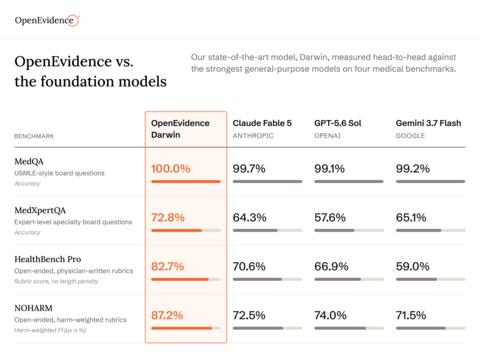
OpenEvidence Darwin is the most advanced medical AI model in the world, now in research preview.
“Every model in the family is held to the same standard of clinical accuracy. What varies is time: how long a model thinks, and how deep it searches.”
Daniel Nadler, Founder and CEO
The names are commitments.
Osler. William Osler moved medicine from the lecture hall to the bedside. He is the reason a physician learns by standing next to the patient. OpenEvidence Osler is the model at the bedside, answering at the speed of the patient encounter. Osler is the successor to the model that currently powers OpenEvidence answers, and becomes the default model on OpenEvidence.
Sackett. David Sackett is remembered as the father of evidence-based medicine. OpenEvidence Sackett is the model that reads the way Sackett taught: interactively asking the clinician for further clinical context and patiently and methodically weighing all of the evidence.
Snow. John Snow founded modern epidemiology when he traced the 1854 Broad Street cholera outbreak, case by case, to a single water pump. OpenEvidence Snow, the successor to OpenEvidence Deep Consult, operates as a team of equally tenacious Ph.D.-level experts in your pocket. Snow runs down every line of inquiry through the literature, in parallel, before it commits to a report.
Osler, Sackett, and Snow are rolling out to all OpenEvidence users today, free to verified clinicians. All three models are available on openevidence.com and the OpenEvidence iOS/Android Apps, so clinicians can match the model to the time they have.
There is a fourth model.
OpenEvidence Darwin is the most advanced medical AI model in the world, now in research preview. It is the first AI model in history to achieve a perfect score on MedQA, the leading independent benchmark of medical AI. We are publishing the results alongside Darwin’s explanation for every answer. Darwin also leads every other major benchmark of medical AI: MedXpertQA (72.8%), HealthBench Professional (82.7%), and NOHARM (87.2%), ahead of the next-best models (Claude Fable 5 and Gemini 3.7).
Capability in medicine is inherently dual-use: a model that can reason at the frontier of virology, immunology, and human genetics could also, in the wrong hands, accelerate work the world tightly governs for good reason, such as bioweapons-relevant research and germline editing outside mainstream scientific oversight. Consistent with the safety frameworks now standard at the AI frontier, Darwin is available by application only.
Today that means institutional partners such as the National Organization for Rare Disorders (NORD), which brings Darwin its hardest cases; research collaborators; and accredited AI researchers at academic institutions benchmarking the accuracy and safety of AI in clinical medicine. As Darwin’s safeguards are validated with these partners, its capabilities will flow, model by model, into Osler, Sackett, and Snow — the frontier arriving at the point of care as fast as it can arrive safely.
The OpenEvidence Model Family represents the next generation of medical AI search models, available today for free for verified clinicians.
About OpenEvidence
OpenEvidence is the most popular AI for doctors in the United States. According to independent studies, more American physicians use OpenEvidence than all other AI platforms combined. OpenEvidence is trusted by millions of verified U.S. healthcare professionals making high-stakes clinical decisions at the point of care, with evidence that is sourced, cited, and grounded in peer-reviewed medical literature. Founded with the mission to organize and expand the world’s collective medical knowledge, OpenEvidence is now used daily, on average, by the majority of physicians in the United States. OpenEvidence is free for all verified U.S. clinicians. Learn more at openevidence.com.
View source version on businesswire.com: https://www.businesswire.com/news/home/20260903878517/en/
Media gallery


