Data Center Liquid Cooling Market is growing as AI and high-density computing drive demand for efficient, scalable thermal management solutions.
NEW YORK, NY, UNITED STATES, September 4, 2026 /EINPresswire.com/ — The Data Center Liquid Cooling Market is expanding rapidly as data centers deploy high-density servers, AI accelerators, and advanced computing infrastructure. Liquid cooling provides more efficient heat removal than conventional air-based systems, helping operators manage rising thermal loads while improving energy efficiency, reliability, and rack density.
Demand is increasing across hyperscale data centers, colocation facilities, enterprise infrastructure, and high-performance computing environments. The adoption of artificial intelligence, machine learning, cloud computing, and accelerated computing is creating greater demand for cooling technologies capable of supporting high-power processors and dense server configurations.
As computational workloads become more demanding, traditional air-cooling faces limitations in handling concentrated heat loads. Direct-to-chip cooling, immersion cooling, and rear-door heat exchangers are therefore gaining attention as data center operators seek scalable thermal management solutions that can support next-generation infrastructure.
Download Exclusive Sample Copy of This Report Here –
https://www.marketresearchfuture.com/sample_request/24844
Market Size and Growth
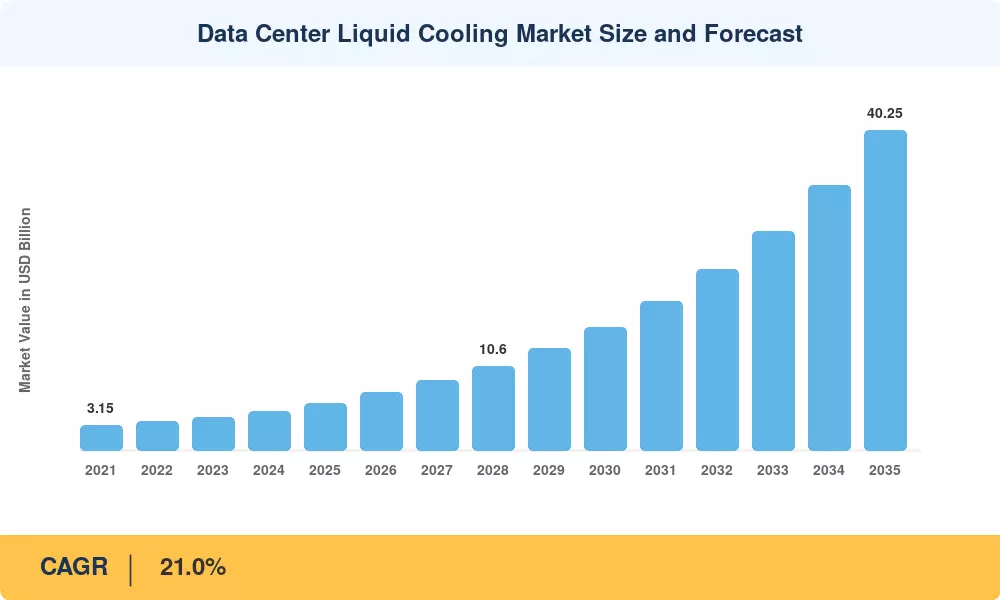
Data center liquid cooling market was valued at USD 5.90 billion in 2025 and is projected to reach USD 7.24 billion in 2026 before climbing to USD 40.25 billion by 2035, registering a CAGR of 21.0% across the 2026–2035 forecast window. This strong growth reflects the increasing deployment of AI servers, GPU-intensive computing, and high-performance workloads. Liquid cooling enables facilities to address higher thermal design power while potentially reducing cooling energy requirements and supporting more efficient data center operations.
The market is also benefiting from the modernization of existing facilities and the development of purpose-built AI data centers. Operators are increasingly evaluating cooling infrastructure during facility design rather than treating thermal management as a secondary infrastructure requirement.
Key Market Drivers
The rapid adoption of artificial intelligence is one of the major factors driving the Data Center Liquid Cooling Market. AI training and inference workloads rely heavily on GPUs and specialized accelerators that generate substantial heat, increasing demand for advanced cooling technologies. The growth of hyperscale and cloud data centers is another important market driver. Large-scale facilities require dependable thermal management across thousands of servers, making efficient cooling systems increasingly important for maintaining equipment performance, availability, and operational efficiency.
Rising rack power density is also accelerating adoption. As computing equipment becomes more powerful, conventional air-based systems can face thermal and space constraints, encouraging data center operators to consider direct liquid cooling and other advanced heat-removal approaches.
Artificial Intelligence and High-Density Computing
AI infrastructure is changing data center thermal requirements by concentrating more computing power into individual racks. GPUs and AI accelerators can generate significantly higher heat loads than conventional enterprise servers, creating new challenges for facility cooling systems. The Data Center Liquid Cooling Market is consequently positioned to benefit from AI infrastructure expansion. Direct-to-chip systems can transfer heat directly from high-power components into a liquid loop, improving thermal management for demanding computational workloads.
High-performance computing, scientific simulations, financial modeling, and advanced analytics are also contributing to demand. These applications require sustained computational performance, making effective temperature control essential for maintaining system stability and minimizing performance degradation.
Data Center Liquid Cooling Technologies
Direct-to-chip cooling is emerging as an important technology because it places cooling components close to high-heat-generating processors. Heat is transferred from CPUs, GPUs, or accelerators into a liquid circuit, allowing facilities to manage high thermal loads more effectively.
Immersion cooling represents another growing approach, where computing equipment is immersed in a specialized non-conductive liquid. This method can provide highly efficient heat transfer and may support extremely high-density computing environments where traditional cooling architectures become difficult to scale.
Rear-door heat exchangers offer an alternative approach for facilities transitioning toward liquid-assisted cooling. These systems capture heat at the server rack and transfer it away through a liquid-cooled heat exchanger, providing a practical option for selected retrofit applications.
Energy Efficiency and Sustainability
Energy efficiency has become an important consideration for data center operators because cooling can represent a significant portion of facility electricity consumption. Liquid cooling can improve thermal efficiency by transferring heat more directly than conventional air-based approaches.
Sustainability initiatives are further encouraging investment in advanced cooling infrastructure. Operators are evaluating technologies that can reduce cooling energy, optimize water consumption, and support improved power usage effectiveness across data center facilities.
Heat recovery is also creating additional opportunities. Captured thermal energy can potentially be redirected toward district heating, industrial processes, or other applications, particularly in regions where regulations and infrastructure support data center heat reuse.
Buy this Premium Research Report at:
https://www.marketresearchfuture.com/checkout?currency=one_user-USD&report_id=24844
Regional Market Share Analysis
North America
North America accounted for approximately 42% of revenue share in 2025, making it a leading regional market for liquid cooling technologies. Investment is supported by hyperscale AI campuses, cloud infrastructure expansion, and increasing demand for high-density computing environments.
The region is also influenced by energy-efficiency requirements and data center performance standards. Large technology companies and infrastructure operators are investing in advanced thermal-management systems to accommodate expanding AI workloads and next-generation computing platforms.
Europe
Europe represented around 26% of revenue share in 2025, supported by data center modernization and growing emphasis on sustainable infrastructure. Operators are increasingly examining energy efficiency, heat reuse, and environmentally responsible cooling solutions.
Regulatory attention toward environmental impacts and coolant technologies is influencing investment decisions. Heat-reuse initiatives and the transition toward suitable coolant solutions are expected to support further development of the regional liquid cooling ecosystem.
Asia-Pacific
Asia-Pacific is expected to register a strong 24.8% CAGR during the 2026–2035 forecast period. Expanding cloud adoption, AI investment, digital transformation, and sovereign computing programs are increasing demand for advanced data center infrastructure.
New greenfield data centers provide opportunities to integrate liquid cooling from the initial design stage. Countries investing heavily in AI and digital infrastructure are likely to accelerate adoption as computing density and rack-level power requirements increase.
South America
South America generated approximately USD 0.30 billion in 2025, with growth supported by cloud infrastructure development and telecommunications expansion. Brazil remains an important market as providers expand regional data center capacity to serve growing digital demand.
Telecom edge deployments and new cloud zones are creating additional opportunities for efficient thermal management. Liquid cooling can become increasingly relevant as edge facilities and high-density computing deployments require compact and reliable cooling architectures.
Middle East & Africa
The Middle East and Africa market is projected to grow at a 22.0% CAGR from 2026 to 2035. Digital transformation programs, smart-city developments, and new technology hubs are driving investment in advanced data center infrastructure.
Large-scale projects associated with smart cities and digital economies are creating demand for energy-efficient facility technologies. The UAE and other regional technology hubs are expected to contribute to the adoption of advanced cooling systems for high-density computing.
Market Opportunities
The expansion of AI-focused data centers presents a major opportunity for liquid cooling providers. Purpose-built facilities can incorporate direct liquid cooling infrastructure from the beginning, allowing operators to optimize rack layouts, thermal distribution, and power capacity.
Retrofit solutions represent another attractive opportunity because many existing facilities were originally designed around air cooling. Modular liquid cooling systems can help operators introduce advanced thermal management while minimizing disruption to existing infrastructure.
Another opportunity lies in coolant innovation and thermal-management software. Improved coolants, monitoring systems, sensors, pumps, heat exchangers, and intelligent controls can help operators optimize cooling performance and identify thermal issues before they affect critical equipment.
Key Market Trends
One major trend in the Data Center Liquid Cooling Market is the movement toward higher rack densities. AI and accelerated computing are pushing operators to rethink conventional infrastructure and adopt cooling technologies capable of supporting increasingly concentrated workloads.
Another trend is the integration of liquid cooling with intelligent facility-management platforms. Real-time monitoring can track temperatures, flow rates, pressure, and system performance, enabling operators to optimize cooling resources according to changing computational loads.
Hybrid cooling architectures are also gaining attention. Data centers may combine air cooling with liquid-based technologies depending on rack requirements, providing greater flexibility when deploying mixed workloads and gradually transitioning existing facilities toward higher-density infrastructure.
Challenges in the Market
Despite its growth potential, liquid cooling can involve higher initial infrastructure complexity than conventional air cooling. Operators may need specialized distribution systems, pumps, heat exchangers, controls, maintenance procedures, and compatible server components.
Maintenance and operational expertise can also influence adoption. Data center personnel need appropriate training to manage liquid distribution systems, detect leaks, maintain coolant quality, and ensure reliable operation across critical infrastructure.
Compatibility with existing facilities remains another challenge. Retrofitting older data centers can require modifications to racks, piping, power infrastructure, and cooling distribution systems, potentially increasing deployment costs and project complexity.
Competitive Landscape
The competitive environment includes data center cooling specialists, thermal-management companies, server manufacturers, infrastructure providers, and technology firms developing liquid cooling solutions. Companies are focusing on direct-to-chip systems, immersion platforms, cooling distribution units, and integrated thermal-management technologies.
Strategic partnerships are becoming increasingly important as cooling systems must integrate with servers, racks, facility infrastructure, and data center management platforms. Collaboration across the technology ecosystem can accelerate deployment and improve system compatibility.
Research and development will remain central to competition. Vendors are working to improve cooling efficiency, scalability, reliability, coolant management, monitoring capabilities, and integration with high-density AI infrastructure.
Browse In-depth Market Research Report:
https://www.marketresearchfuture.com/reports/data-center-liquid-cooling-market-24844
Future Outlook
The future of the Data Center Liquid Cooling Market is closely connected to the expansion of AI, cloud computing, high-performance computing, and accelerated workloads. As processors become more powerful and rack densities increase, advanced thermal management will become increasingly important.
Over the coming years, liquid cooling is expected to move from a specialized solution toward a more mainstream component of high-density data center design. New facilities are particularly well positioned to adopt these systems because cooling infrastructure can be integrated during initial engineering and construction.
The market will also increasingly focus on sustainability, energy optimization, heat recovery, and intelligent cooling management. These developments could strengthen the role of liquid cooling as data center operators balance performance requirements with operational efficiency and environmental objectives.
Key Takeaways
The Data Center Liquid Cooling Market is experiencing strong growth because AI and high-performance computing are increasing server heat densities. Direct-to-chip, immersion, and hybrid cooling technologies are gaining importance as conventional air cooling reaches practical limitations. North America currently leads regional revenue share, while Asia-Pacific and the Middle East & Africa offer significant growth potential. Sustainability requirements, AI infrastructure investment, hyperscale expansion, and high-density computing will remain major factors shaping market development.
Frequently Asked Questions:
What is the Data Center Liquid Cooling Market?
It covers technologies and systems that use liquid-based thermal management to remove heat from servers and high-density computing equipment.
Why is liquid cooling important for data centers?
Liquid cooling efficiently manages high heat loads generated by AI processors, GPUs, CPUs, and other high-performance computing components.
What is driving market growth?
AI adoption, hyperscale data center expansion, increasing rack density, cloud computing, and energy-efficiency requirements are key growth drivers.
Which region currently leads the market?
North America held the largest reported revenue share, accounting for approximately 42% in 2025.
What are the major liquid cooling technologies?
Key technologies include direct-to-chip cooling, immersion cooling, rear-door heat exchangers, and hybrid cooling architectures.
➤➤ In-Depth Market Studies by Market Research Future:
Data Center Market –
https://www.marketresearchfuture.com/reports/data-centre-market-4721
Data Center Infrastructure Market –
https://www.marketresearchfuture.com/reports/data-center-infrastructure-market-4544
Data Center Service Market
https://www.marketresearchfuture.com/reports/data-center-service-market-2497
Data Center Construction Market –
https://www.marketresearchfuture.com/reports/data-center-construction-market-5809
Hyperscale Data Center Market –
https://www.marketresearchfuture.com/reports/hyperscale-data-center-market-5878
Edge Data Center Market –
https://www.marketresearchfuture.com/reports/edge-data-center-market-4180
Data Center Service Market –
https://www.marketresearchfuture.com/reports/data-center-service-market-2497
Data Center Security Market –
https://www.marketresearchfuture.com/reports/data-center-security-market-4785
Modular Data Center Market –
https://www.marketresearchfuture.com/reports/modular-data-center-market-7701
Data Center Life Cycle Services Market –
https://www.marketresearchfuture.com/reports/data-center-life-cycle-services-market-3872
Market Research Future
Market Research Future
+1 855-661-4441
email us here
Legal Disclaimer:
EIN Presswire provides this news content “as is” without warranty of any kind. We do not accept any responsibility or liability
for the accuracy, content, images, videos, licenses, completeness, legality, or reliability of the information contained in this
article. If you have any complaints or copyright issues related to this article, kindly contact the author above.

Media gallery