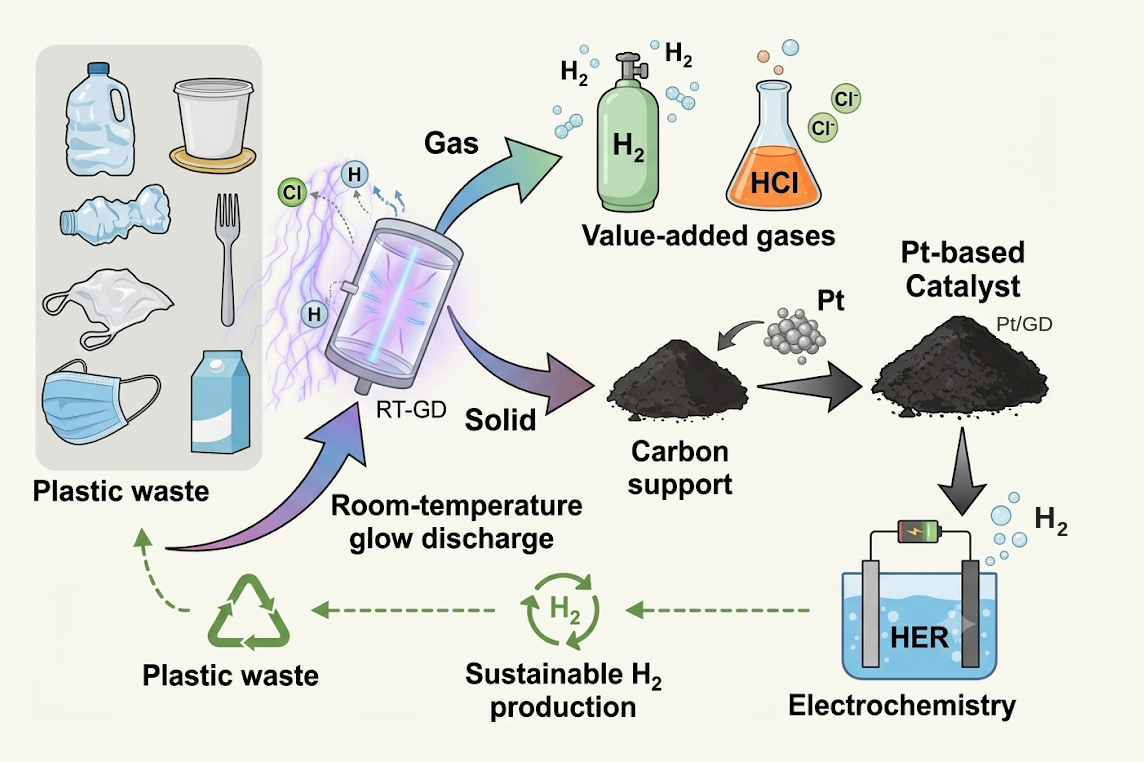
A new study explores how room-temperature plasma can transform PVC waste into hydrogen, recoverable chemicals and useful carbon materials.
CHINA, November 23, 2026 /EINPresswire.com/ — What if difficult-to-recycle plastic waste could be turned into a source of clean hydrogen and useful materials? Researchers have explored this possibility using an innovative plasma-based process that converts polyvinyl chloride (PVC) waste into valuable resources at temperatures below 40°C.
Published in Green Chemical Engineering, the study introduces a glow-discharge technology that breaks down PVC while recovering its useful components. PVC is widely used in everyday products but is challenging to recycle because of its chemical stability and chlorine content.
The new process offers a different approach. It breaks specific chemical bonds in PVC while largely preserving its carbon structure, producing three valuable outputs:
Hydrogen: The main gaseous product, with a yield of 2.5 kmol/(h·m²).
Hydrogen chloride (HCl): Captured in the liquid phase for potential recovery and use.
Functional carbon: The remaining material is converted into conductive carbon that can support energy-related applications.
Notably, the process generates no carbon monoxide or carbon dioxide.
The researchers also explored whether the recovered carbon, named GD60, could be used in energy applications. Its improved electrical conductivity and ability to interact with water made it suitable as a support for catalysts. Using this material, the team developed a catalyst containing just 1 wt% platinum. In tests for hydrogen production, it showed higher electrocatalytic activity than a commercial catalyst containing 20 wt% platinum.
This finding points to another opportunity: materials recovered from plastic waste could help reduce the amount of precious metals needed in certain energy technologies.
By combining plastic waste treatment with hydrogen recovery and material reuse, this approach could offer a more resource-efficient way to manage difficult-to-recycle plastics. Although further research is needed to assess its scalability and performance under industrial conditions, the findings open up possibilities for turning plastic waste into useful resources rather than treating it solely as a disposal problem.
About Green Chemical Engineering:
Green Chemical Engineering is an international, peer-reviewed journal covering sustainable chemistry and chemical engineering. It is indexed in ESCI, EI, Scopus and CSCD, with an Impact Factor of 11.9 (JCR Q1) and a citescore of 18.5.
Read the full research article: https://doi.org/10.1016/j.gce.2026.09.005
Andrew Smith
Charlesworth Yansci
+44 7478 953600
marketing@charlesworth-group.com
Visit us on social media:
Bluesky
X
Other
Legal Disclaimer:
EIN Presswire provides this news content “as is” without warranty of any kind. We do not accept any responsibility or liability
for the accuracy, content, images, videos, licenses, completeness, legality, or reliability of the information contained in this
article. If you have any complaints or copyright issues related to this article, kindly contact the author above.

Media gallery