Researchers developed a mineralized DNA hydrogel that coordinates immune regulation and sustained bone regeneration for complex skeletal defects
CHENGDU, SICHUAN, CHINA, June 3, 2026 /EINPresswire.com/ — A new study developed a mineralized DNA hydrogel that combines immune regulation with sustained bone regeneration. Using tetrahedral DNA nanostructures and calcium phosphate mineralization, researchers created a scaffold that promotes healing-friendly macrophage activity while supporting bone-forming stem cells. In animal models, the material accelerated bone repair, improved tissue mineralization, and prolonged structural stability. The findings may advance next-generation biomaterials for craniofacial reconstruction, traumatic injuries, and challenging bone healing disorders worldwide.
Bone defects caused by trauma, infection, tumors, or congenital disorders remain a major clinical challenge. Surgeons commonly rely on bone grafts, but these procedures present significant hurdles, including limited donor availability, immune rejection, infection risks, and additional surgeries. Researchers in tissue engineering have therefore been searching for biomaterials that can guide the body to regenerate bone naturally while also controlling inflammation during healing. Although hydrogels can mimic the body’s extracellular matrix, many existing materials degrade too quickly and fail to provide long-term regenerative support.
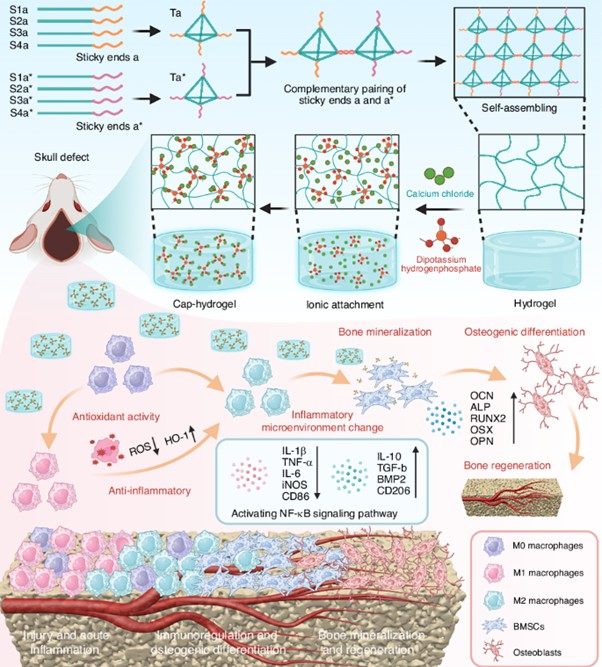
Addressing this challenge, a research team was led by Prof. Yunfeng Lin and Prof. Taoran Tian from State Key Laboratory of Oral Diseases & National Center for Stomatology, West China Hospital of Stomatology, Sichuan University, China. The researchers developed a mineralized DNA hydrogel called “Cap-gel” using tetrahedral framework nucleic acids, tiny programmable DNA nanostructures that self-assemble into stable three-dimensional scaffolds. The material was engineered to combine immune regulation with sustained osteogenic activity through controlled calcium phosphate mineralization. Their findings were made available online on May 8, 2026, in Volume 14 of the journal Bone Research.
The scientists focused on two biological processes essential for bone repair: inflammation control and osteogenesis, the formation of new bone tissue. Cap-gel was designed to encourage macrophages to switch into the “M2” healing phenotype, which promotes tissue regeneration. Laboratory experiments showed that the material reduced inflammatory markers, including IL-6 and TNF-α, while increasing anti-inflammatory and regenerative signals such as IL-10, TGF-β, and BMP2. The hydrogel also lowered oxidative stress in immune cells, helping create a more favorable healing environment.
At the same time, the mineralized structure of Cap-Gel acted as a long-term reservoir of calcium ions, which are crucial for bone formation and cellular signaling. The researchers found that the hydrogel gradually released calcium over several weeks, activating pathways linked to osteogenic differentiation. Bone marrow stem cells exposed to Cap-gel showed stronger expression of osteogenic proteins, including RUNX2, ALP, osteopontin, and collagen I, compared with control groups. The material also promoted the formation of mineralized nodules, demonstrating active bone-building activity.
“Our goal was to create a biomaterial that does more than simply fill a defect,” explained Professor Lin. “We wanted a scaffold that could actively communicate with immune cells and stem cells so the healing environment becomes regenerative from the very beginning.”
To evaluate the material in living systems, the team implanted Cap-Gel into skull bone defects in rats. Imaging and tissue analyses showed that the hydrogel accelerated bone repair. Early after implantation, the material reduced inflammatory infiltration and increased the presence of pro-healing macrophages. Over time, defects treated with Cap-Gel developed denser collagen networks, more organized bone structures, and greater bone volume than untreated controls or non-mineralized hydrogels. After eight weeks, the regenerated bone displayed mature architecture and stronger mineralization.
The researchers believe the study could encourage collaborations across regenerative medicine, biomaterials science, nanotechnology, and immunology. Because the material combines programmable DNA nanostructures with bioactive mineral components, it may inspire future strategies for cartilage repair, dental reconstruction, chronic wound healing, and implant integration. The ability to direct immune responses while supporting tissue regeneration is increasingly considered critical for successful biomedical engineering.
Prof. Tian said the project was motivated by challenges in craniofacial repair. “Patients with severe bone defects often require multiple surgeries and prolonged recovery,” he noted. “By designing materials that work together with the body’s immune system, we hope to reduce complications and improve long-term healing outcomes.”
Overall, the findings demonstrate how programmable DNA nanotechnology can be combined with mineral engineering to create a new generation of regenerative biomaterials. By integrating immune modulation with sustained osteogenesis, Cap-Gel offers a promising framework for therapies aimed at repairing difficult bone defects while harnessing the body’s natural healing potential.
Reference
Titles of original paper:
Journal: Mineralized DNA tetrahedron-structured hydrogels: a dual-functional Scaffold for immunomodulation and bone regeneration
Bone Research
DOI: 10.1038/s41413-026-00530-8
About Sichuan University, China
Sichuan University is one of China’s leading comprehensive research universities, with strong programs in medicine, engineering, materials science, life sciences, and dentistry. Located in Chengdu, the university supports interdisciplinary innovation through nationally recognized laboratories, collaborative research centers, and advanced translational medicine initiatives. West China Hospital of Stomatology and the State Key Laboratory of Oral Diseases are internationally recognized for research in craniofacial biology, regenerative medicine, and biomaterials. Sichuan University actively promotes global academic partnerships and technology-driven healthcare solutions that address major clinical challenges in China and worldwide.
Website: https://en.scu.edu.cn/
About Professor Yunfeng Lin
Prof. Yunfeng Lin is currently a Professor at the State Key Laboratory of Oral Diseases, Sichuan University, China. He also serves as Vice-director of the State Key Laboratory of Oral Diseases and Assistant Dean of the West China School of Stomatology. He received his Ph.D. from Sichuan University in 2006. His research focuses on adipose stem cell differentiation and craniofacial regeneration involving bone, cartilage, tooth, and adipose tissues. He has published more than 60 papers, reviews, and book chapters, contributing significantly to stem cell and regenerative medicine research. He received the New Century Excellent Talents award from China’s Ministry of Education.
About Professor Taoran Tian
Prof. Taoran Tian is an Associate Professor in the Department of Implantology. His research interests include regenerative medicine, adult stem cells, tissue engineering, biomaterials, DNA nanotechnology, stem cell culture, polymerase chain reaction, Western blotting, and cell viability analysis. Prof. Tian has authored 101 scientific publications with 5,591 citations. His work focuses on developing biomaterial-based regenerative therapies for oral and craniofacial repair by integrating nanotechnology, stem cell biology, and tissue engineering approaches to support translational and clinically relevant regenerative medicine applications.
Funding Information
This study was supported by the National Natural Science Foundation of China (82201027 and 82370929). Fundamental and Interdisciplinary Disciplines Breakthrough Plan of the Ministry of Education of China (Grant No. JYB2025XDXM610). Young Elite Scientists Sponsorship Program by CAST (YESS20240133). Major Science and Technology Special Project of Sichuan Province (2025ZDZX0131), Leading Scientist Program for Basic Research of Sichuan Province (2025JDKXJ0001), The Sichuan Science and Technology Program (2024NSFSC1591 Sichuan Province Youth Science and Technology Innovation Team (2022JDTD0021), Health Commission of Sichuan Province Medical Science and Technology Program (24CGZH02), Research and Develop Program, the West China Hospital of Stomatology Sichuan University (RD03202302, RCDWJS2024-1).
Yini Bao
2885546461 ext.
br@scu.edu.cn
Sichuan University, China
Visit us on social media:
X
Other
Legal Disclaimer:
EIN Presswire provides this news content “as is” without warranty of any kind. We do not accept any responsibility or liability
for the accuracy, content, images, videos, licenses, completeness, legality, or reliability of the information contained in this
article. If you have any complaints or copyright issues related to this article, kindly contact the author above.

Media gallery