GA, UNITED STATES, June 3, 2026 /EINPresswire.com/ — Numerical simulation is essential for predicting how complex mechanical systems move, from robots and vehicles to deployable aerospace structures. Yet fast prediction often comes at a cost: traditional numerical methods can be accurate but time-consuming, while pure data-driven neural networks may lose reliability when facing strong nonlinear behavior. A new study proposes a mechanism-data hybrid-driven strategy that brings mechanical laws into neural-network training. By combining differential-algebraic equations (DAEs) with a physics-informed neural network (PINN), the method aims to make dynamic prediction faster, more stable and more faithful to the real motion constraints of multibody systems.
Multibody systems (MBSs) are made of connected mechanical components that move under constraints, such as joints, rods, sliders or panels. Their mathematical models are often expressed as ordinary differential equations (ODEs) or differential-algebraic equations (DAEs), which can become highly nonlinear and difficult to solve efficiently. Numerical integration methods remain powerful, but repeated iterations and Jacobian calculations can limit real-time applications. Deep neural networks (DNNs) offer speed, but their predictions may lack physical consistency if trained only on data. Due to these challenges, there is a need to carry out in-depth research on reliable, physics-aware data-driven methods for multibody dynamics.
A research team from Dalian University of Technology, including the School of Mechanics and Aerospace Engineering and the School of Mechanical Engineering, published the study in Acta Mechanica Sinica. The work develops a physics-informed neural network (PINN)-based hybrid method for nonlinear multibody systems, using mechanical equations and training data together to improve prediction accuracy, robustness and generalization under changing system parameters.
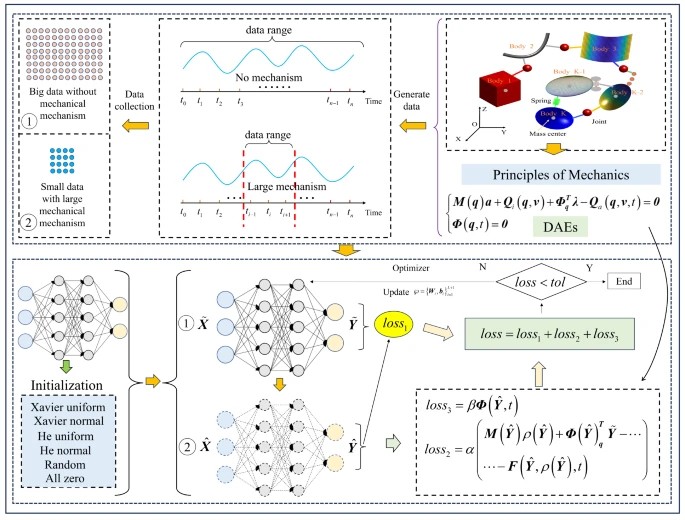
The study builds the hybrid strategy around a simple but important idea: a neural network should not only match training data, but also satisfy the governing mechanical equations and kinematic constraints of the system. To do this, the authors introduced scaling coefficients into the loss function, allowing the dynamic model of the MBS to guide neural-network learning. The framework separates data into a large dataset used for fitting and a smaller mechanism-informed dataset used to correct the network against physical laws. Automatic differentiation is then used to obtain velocity and acceleration from predicted position variables, helping the model satisfy the DAEs. The team tested the method on three representative systems: a simple pendulum, a slider-crank mechanism and a satellite panel system. The proposed method was compared with artificial neural network (ANN) predictions, tested under noisy data, and examined across different driving velocities, external forces, time steps, hidden layers and neuron numbers. Results showed better constraint preservation, stronger stability and faster prediction, with constraint violations generally controlled between 10−2 and 10−4.
The authors said the study shows how mechanical knowledge can make neural networks more trustworthy for engineering simulation. Rather than treating the model as a black box, the method gives the network a “sense” of the system’s physical rules, they said. This is especially important for nonlinear systems where small prediction errors can lead to large residuals in the governing equations. By embedding mechanism information into learning, the approach offers a practical route toward faster simulations that remain connected to real mechanical behavior.
The findings may support future real-time analysis and design of robotic systems, vehicle mechanisms, aerospace deployable structures and other mechanical assemblies where speed and reliability are both required. The hybrid framework also provides a reference for broader scientific computing tasks that need to balance data efficiency with physical interpretability. As engineering systems become more complex and data-rich, physics-guided learning methods could help reduce computational cost while improving confidence in simulation results. Future work may extend this strategy to larger, more flexible and more strongly coupled systems, moving AI-assisted mechanical simulation closer to practical engineering use.
References
DOI
10.1007/s10409-024-24159-x
Original Source URL
https://doi.org/10.1007/s10409-024-24159-x
Funding information
This work was supported by the National Natural Science Foundation of China (Grant No. U2241263), and the fellowship of China Postdoctoral Science Foundation (Grant No. 2024M750310).
Lucy Wang
BioDesign Research
email us here
Legal Disclaimer:
EIN Presswire provides this news content “as is” without warranty of any kind. We do not accept any responsibility or liability
for the accuracy, content, images, videos, licenses, completeness, legality, or reliability of the information contained in this
article. If you have any complaints or copyright issues related to this article, kindly contact the author above.

Media gallery