
The hardest part of starting an online store is rarely creating the listing.
It is getting enough interested buyers to see it.
That is why live-selling platforms such as Whatnot have attracted attention. Instead of building a website, waiting for search traffic, or paying for advertising before testing a product, sellers can present items to shoppers already browsing the marketplace.
Rachel Rofe’s Quick Audience WhatNot Mentorship Program is designed to help beginners enter that environment with a clearer plan. The program combines training, software-assisted research, show-planning resources, coaching, support, and a private community.
That sounds convenient. But convenience is not the same as certainty.
Those who are interested in watching more detailed evaluations can visit the following site:https://www.onlinecosmos.com/p/video-review-of-quick-audience-2026
This quick audience review examines the most important and sometimes counterintuitive lessons from the program. The goal is not to repeat sales-page promises. It is important to understand what buyers receive, what live selling demands, and who may realistically benefit from the system.
“The report is intended to help prospective Whatnot sellers understand what the program includes, what live selling requires in practice, and what factors should be considered before making a purchase.”
Here are nine truths worth understanding before making a decision.
1. The real shortcut is not instant sales—it is fewer uncertain decisions.
New sellers usually do not struggle because information is unavailable.
They struggle because there is too much scattered information.
A beginner may spend weeks trying to answer basic questions:
- What products should be sold?
- How much inventory is enough?
- How should a live show begin?
- What’s a reasonable auction price?
- How to figure out costs and margins?
- What if there aren’t many people who come to watch?
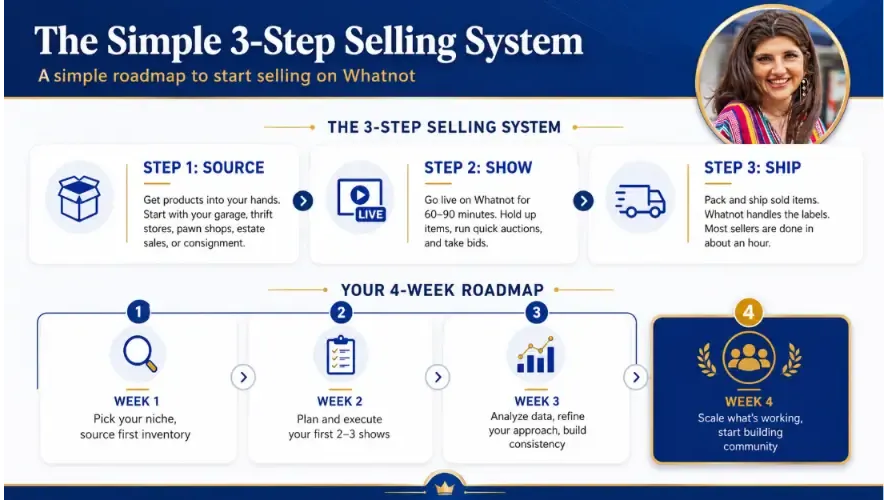
The Quick Audience Profit System tries to put those decisions into a repeatable process.
Its core workflow covers sourcing products, preparing a show, presenting or auctioning items, fulfilling orders, encouraging repeat purchases, and restocking based on demand.
The biggest potential benefit is therefore not a secret product or guaranteed result. It is reduced confusion.
That matters because indecision has a cost. Every week spent collecting disconnected tips is another week without testing products, speaking with buyers, or learning from a real show.
For a self-directed seller, free Whatnot education may be enough. For someone who needs a structured path, the organization itself may be one of the program’s strongest features.
2. A simple business model can still require serious work.
The Whatnot model is straightforward to explain:
Find an item, show it live, sell it, ship it, and repeat.
That simplicity is attractive. It can also create the wrong expectation.
Live selling is not automatically hands-off. A seller may still need to
- Research product demand
- Source and inspect inventory
- Prepare listings
- Organize the filming area
- Schedule and promote shows
- Present products clearly
- Answer buyer questions
- Track completed sales
- Package and ship orders
- Handle refunds or customer concerns
- Restock successful products
A 60-minute show may require additional time before and after the broadcast.
That is one of the most important findings in this Quick Audience Profit System review. The program may simplify the learning process, but it does not remove the operational work.
The distinction matters because the wrong expectation can turn a reasonable program into a disappointing purchase.
A buyer expecting an automated system may feel overwhelmed. A buyer expecting an active resale operation may view the same workload as normal.
3. The software can improve decisions, but it cannot create demand.
Quick Audience includes tools designed to support product research, niche selection, show planning, and cost analysis.
The reported tools include resources such as the following:
- Profit Radar for evaluating potential products
- Opportunity Hunter for exploring categories
- Act as an architect for organizing live show flow
- Profit X-Ray Pro for examining costs and margins
These tools address real problems.
Poor product selection can lock money into inventory that does not move. Weak show planning can create awkward pauses. Incomplete cost calculations can make healthy-looking sales figures less attractive after expenses.
But software recommendations should not be taken as guarantees.
A product can appear promising and still sell slowly. A category can become crowded. An item with a healthy projected margin can lose appeal once you consider packaging, platform charges, promotions, refunds, or unsold stock.
The tools may help sellers ask better questions. They cannot replace judgment, testing, or market feedback.
That is not a flaw unique to Quick Audience. It is a reality of every product-based marketplace.
4. The coaching may be more valuable than the recorded lessons.
Most online courses contain more information than buyers ever use.
Access is rarely the problem. It is implementation.
Quick Audience includes weekly coaching calls, a support desk, and a private member community. These resources may be especially useful when a seller faces a specific problem that a general lesson cannot fully answer.
Examples might include:
- Whether a particular product has enough margin
- How to structure a first show
- Why viewers are leaving early
- Whether an auction price is too low
- How to improve a slow-moving category
- What to change after an unsuccessful session
Recorded training explains the process. Coaching can help apply that process to a real situation.
But access alone does not create value.
A member who attends calls, prepares focused questions, shares actual results, and applies the feedback may receive considerably more benefit than someone who only watches the lesson library.
This creates an uncomfortable but useful truth: the most valuable parts of the program may also be the easiest parts to ignore.
5. The enrollment fee is not the complete cost.
A common mistake when evaluating training is comparing only the course price with possible sales.
That calculation is incomplete.
Depending on the seller’s setup and category, other expenses may include:
- Inventory
- Packaging materials
- Storage
- Lighting
- A phone stand or camera mount
- Label-printing equipment
- Platform and payment charges
- Giveaways or promotions
- Refunds and cancellations
- Working capital
- Unsold products
Time also has a cost.
Gross sales do not show how many hours you spent sourcing, preparing, streaming, packing, and resolving problems. They also do not show how much money remains after every expense.
This is why isolated sales screenshots should not be the main reason for joining.
A more useful question is the following:
Can the complete operating model work with the available budget, time, product access, and fulfillment capacity?
That question is less exciting than a revenue figure. It is also far more useful.
6. Camera-shy sellers may have more options than expected.
A common concern about Whatnot is the need to appear on camera.
That may not always be necessary.
Some sellers use:
- Hands-only product demonstrations
- Overhead camera angles
- Rotating product displays
- Voice-led presentations
- Product-focused close-ups
This approach makes the model more accessible to introverts and sellers who prefer not to build a personality-centered brand.
However, faceless does not mean communication-free.
Sellers still have to describe products accurately, answer questions, explain the value, manage auction pacing, and keep viewers interested.
Certain categories may benefit from a visible host because facial expressions and direct interaction can strengthen trust. Other categories may depend more heavily on the product itself.
The useful takeaway is not that every seller must appear on camera. It is that the presentation style can be adapted—but engagement still matters.
7. A quiet first show is not always evidence that the model failed.
Early live shows might have just a couple of viewers.
That can feel discouraging, especially after you have spent time preparing products, equipment, titles, and listings.
But one quiet session does not provide enough information to judge an entire model.
The first show can reveal the following:
- Which titles attract clicks
- Which products generate questions
- Where viewers lose interest
- Whether auctions move too slowly
- Which prices create resistance
- What presentation style feels natural?
- Which categories deserve another test?
The more useful mindset is to treat early shows as market research rather than final verdicts.
That does not mean continuing indefinitely without evidence. It means gathering enough data to make a fair decision.
A seller who expects immediate momentum may quit before useful patterns appear. A seller who tracks results and improves deliberately has a better chance of understanding what is working—and what is not.
8. Quick Audience may fit existing resellers especially well.
The program is presented as beginner-friendly, but existing resellers may have an overlooked advantage.
Someone already selling through eBay, Etsy, Poshmark, Facebook Marketplace, or local channels may already understand the following:
- Product sourcing
- Pricing
- Customer expectations
- Packaging
- Shipping
- Inventory organization
- Returns
- Marketplace rules
For that person, Whatnot is not an entirely new business. It is a new selling format.
The main learning curve becomes live presentation, show pacing, audience interaction, and auction strategy.
Complete beginners can still use the program, but they must learn both sides at once: the fundamentals of physical-product selling and the mechanics of live commerce.
This does not make the program unsuitable for beginners. It simply means prior resale experience may shorten the adjustment period.
9. Whatnot is not automatically better than Shopify or Amazon FBA.
The best platform is the one that works best for the seller, not necessarily the most popular.
Shopify gives you more control over the look, feel, and experience of your store. The tradeoff is that traffic usually has to be driven through advertising, search, email, social media, partnerships, or content.
Amazon FBA gives you a massive marketplace and takes care of fulfillment. The trade-off could be more complexity in inventory planning, listing optimization, advertising, sourcing, and account management.
Whatnot provides them with access to shoppers already interested in live commerce. The tradeoff is ongoing live participation, reliance on the platform, category competition, and direct fulfillment involvement.
If you are a seller who likes interaction, fast product feedback, testing smaller inventory, and a marketplace-led audience, then Quick Audience might make the most sense.
Shopify could be a better fit for sellers who want to have control over their brand long term.
For sellers that deal with standardized products and have larger-scale fulfillment, Amazon FBA could be a good option.
There are no overall winners. The best choice depends on the availability of funds, the accessibility of products, the style of communication, the capacity for operation, and the preferred way of working.
Is the Quick Audience Profit System worth it?
The Quick Audience Profit System may be worth considering when three conditions are present:
- An eligible Whatnot seller account can be opened.
- Regular live shows and physical fulfillment are realistic.
- The coaching, tools, support, and community will be actively used.
It becomes harder to justify when the buyer is uncertain about live selling, cannot comfortably cover the full cost, dislikes customer interaction, or wants a largely automated model.
The program’s potential value does not come from one isolated feature.
It comes from having product research, show planning, cost analysis, coaching, support, and implementation guidance all organized in one place.
That convenience can be meaningful—but only when it leads to action.
Quick Audience Review: Frequently Asked Questions
What is the Quick Audience Profit System?
It is Rachel Rofe’s training and mentorship program for people interested in selling physical products through live shows on Whatnot.
Does Quick Audience guarantee sales?
No training program can guarantee sales. Outcomes depend on product selection, pricing, category demand, show quality, consistency, costs, and fulfillment.
Are there any costs besides the program fee?
Additional costs include inventory, packaging, equipment, storage, platform fees, promotions, refunds, and working capital.
Is QuickAudience suitable for total beginners?
This program would be great for beginners who want a structure and coaching, but you’ll still need to learn how to source products, do live presentations, and fulfill and provide customer service.
Does it need to be on camera?
Not always. Some categories might work with hands-only, product-centric, and voice-led setups, but you still need to communicate clearly.
Who should avoid the program?
It may not suit people who lack access to Whatnot seller registration, prefer not to run live shows, dislike managing inventory and shipping, or cannot comfortably afford the total cost.
Final Verdict
The most important question is not whether Whatnot live selling can work.
The better question is whether the model fits the buyer’s skills, budget, schedule, and willingness to participate consistently.
Quick Audience offers a more structured path than assembling the process from scattered videos, forums, and trial and error. Its strongest appeal is the combination of training, tools, coaching, support, and community.
That structure may help an action-oriented seller move forward with greater clarity.
It cannot replace thoughtful sourcing, accurate cost calculations, reliable fulfillment, or repeated practice.
Read the complete Quick Audience Profit System review on OnlineCOSMOS:
https://www.onlinecosmos.com/p/video-review-of-quick-audience-2026
Before purchasing, please confirm the current pricing, bonuses, eligibility requirements, support terms, and refund conditions on the official offer page:
.
Disclosure: OnlineCOSMOS may receive compensation from qualifying purchases made through certain links. This shall not increase the price paid by the purchaser. Please read the product details and terms before you decide.
OnlineCOSMOS News
OnlineCOSMOS, WEBZAK Cyber Technologies
Kathiroor
Kerala
670642
India


