XIAMEN, FUJIAN, CHINA, August 13, 2026 /EINPresswire.com/ — For foodservice programs managing high-volume takeaway operations, large-capacity paper buckets present unique sourcing challenges. The structural demands of carrying heavy, hot, or oil-rich foods require more than basic cup-forming capability; they demand precise die cutting, stable material construction, and consistent leak resistance. This guide is designed to help buyers attending the PACKCON exhibition evaluate potential suppliers by focusing on critical production controls. Finding a reliable Custom Paper Bucket Manufacturer means verifying their capacity to handle everything from base material selection to final inspection. Instead of relying on general marketing claims, procurement teams must assess a supplier’s specific expertise in forming large formats, managing custom artwork, and ensuring lid compatibility. As buyers prepare for supplier meetings, understanding these manufacturing phases provides a clearer framework for comparing proposals and securing dependable packaging lines.
PACKCON Paper Bucket Procurement Priorities for Foodservice Programs
When evaluating suppliers at trade events like PACKCON, foodservice procurement teams face the complex task of filtering manufacturers based on genuine production capabilities rather than surface-level product displays. The primary priority is establishing whether a supplier controls the entire manufacturing sequence in-house. A fragmented supply chain—where printing or die cutting is outsourced—often introduces dimensional inconsistencies that compromise lid fit and stacking stability during transport. Buyers must prioritize suppliers that integrate product design, printing, die cutting, and final inspection into a single, cohesive workflow. This end-to-end control is essential for maintaining strict tolerances across large production runs. Additionally, buyers need to confirm that the manufacturer has proven experience in the catering and foodservice sectors, demonstrating an understanding of the operational pressures associated with takeaway and delivery environments. A documentation-first approach to these meetings ensures that discussions remain focused on verifiable quality control processes rather than abstract promises.
Selecting 65 Oz to 170 Oz Paper Bucket Formats
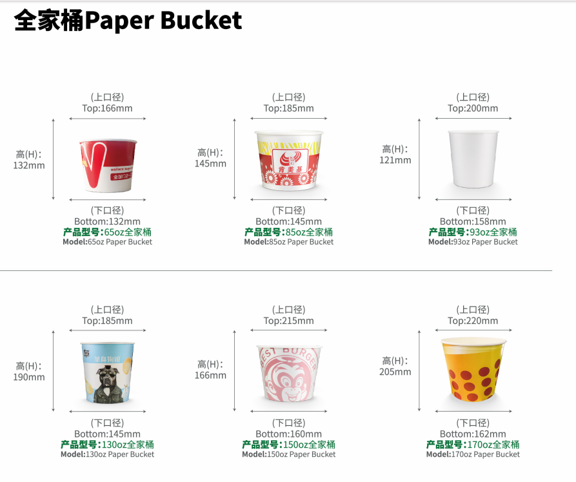
Large-format food containers require a different level of structural integrity compared to standard beverage cups. When reviewing a manufacturer’s portfolio, buyers should look for a comprehensive size matrix that covers the full spectrum of high-capacity serving needs. The ability to supply a continuous range of formats—specifically 65 oz, 85 oz, 93 oz, 130 oz, 150 oz, and 170 oz—demonstrates significant forming expertise. These sizes are typically deployed for heavy, bulk items such as fried chicken and family-style snacks, which exert considerable outward pressure on the container walls. Ensuring that a supplier can consistently produce these large volumes without compromising the structural stability of the bucket is a critical step in the selection process. Buyers must request detailed specifications for each size, confirming that the manufacturer’s forming equipment is properly calibrated to handle the increased paperboard weight and surface area required for these demanding takeaway applications.
White Cardboard Construction, Coating, and Lid Requirements
The performance of a large-capacity food bucket depends heavily on the quality of its base materials. Foodservice operations require packaging that resists moisture and grease penetration during extended delivery times. Procurement teams should verify that the manufacturer utilizes high-grade white cardboard paper designed specifically for demanding food-contact applications. The base board must provide sufficient rigidity to prevent collapsing under load. While visual inspection at an exhibition booth is helpful, buyers must push for specific details regarding the barrier coatings applied to the board. Understanding the coating options available for different food types ensures that the bucket will perform reliably in real-world conditions. Furthermore, the bucket and its lid must function as an integrated system. A secure lid fit is non-negotiable for preventing spills and maintaining food temperature. Buyers should request physical samples to test the lid retention under pressure and ask for documented tolerances regarding rim formation.
Die Cutting and Forming Controls for Consistent Dimensions
The foundation of a reliable paper bucket lies in the precision of its manufacturing equipment. LvSheng emphasizes a one-stop production sequence that directly addresses the need for dimensional consistency. In large-format containers, even a minor deviation during the die-cutting phase can result in a misaligned seam or a distorted rim, ultimately leading to lid failure and product leakage. Buyers must evaluate the supplier’s forming controls, seeking evidence of strict tolerance management throughout the production line. A facility that maintains in-house control over both die cutting and cup forming is better positioned to monitor dimensional accuracy and quickly correct any deviations. Procurement teams should inquire about the specific waterproof testing and dimensional inspection protocols used during active production runs. Understanding how a manufacturer monitors these critical parameters provides confidence that every batch delivered will meet the strict requirements of a high-volume foodservice environment.
Custom Printing, Artwork, and Brand Presentation
In the competitive foodservice sector, packaging serves as a primary vehicle for brand communication. A large paper bucket offers a substantial canvas for custom designs, but executing high-quality artwork on curved, large-format surfaces requires specific printing capabilities. Buyers should verify that the manufacturer supports advanced printing techniques, such as offset and flexographic printing, to achieve accurate color reproduction and sharp brand graphics. The evaluation process must include a review of the supplier’s prepress workflow, including artwork formatting requirements, color matching procedures, and the proofing process. Consistent brand presentation across different bucket sizes and production batches is a key indicator of a supplier’s overall quality control. Procurement teams should ask for examples of custom printed work to assess ink coverage, registration accuracy, and the durability of the print under typical handling conditions. Clear communication regarding print areas and design limitations is essential before finalizing an order.
Carton Configuration and Large Format Logistics Planning
The physical size of 65 oz to 170 oz paper buckets introduces significant logistical challenges that must be addressed during the procurement process. Efficient carton configuration is critical for minimizing shipping costs and maximizing warehouse storage space. Buyers need to confirm the exact carton quantities for each bucket size to calculate accurate freight requirements and plan inventory cycles. Beyond simply knowing the count per box, procurement teams must evaluate the structural strength of the outer packaging. The cartons must protect the buckets from crushing and deformation during transit, ensuring that they arrive at the foodservice outlet in perfect condition. Discussions with the supplier should cover load and stack testing protocols to verify that the packaged product can withstand the rigors of long-distance transport. Thorough logistics planning at the sourcing stage prevents costly operational disruptions and ensures a steady supply of packaging to the end user.
A PACKCON Procurement Scorecard for LvSheng Paper Buckets
To effectively navigate supplier discussions at packaging exhibitions, procurement teams should utilize a structured evaluation scorecard. When reviewing capabilities, buyers must systematically confirm the availability of required sizes, specifically the 65 oz to 170 oz range. The scorecard should prompt questions regarding the exact specifications of the white cardboard material and the available barrier coatings. Critical production phases, such as the precision of die cutting and the consistency of the forming process, must be addressed to ensure reliable lid fit and leak prevention. Buyers should also verify the supplier’s capacity for custom offset or flexographic printing and clarify the artwork approval workflow. Finally, the scorecard must cover logistical factors, including carton configuration, minimum order quantities, sample lead times, and mass production schedules. By systematically gathering this data, foodservice operators can make informed, documentation-backed purchasing decisions for their large-capacity takeaway programs. For more details on production capabilities and custom design solutions, visit https://lvshengpapercup.com/
Xiamen LvSheng Paper & Plastic Products Co., Ltd.
LvSheng
email us here
Visit us on social media:
LinkedIn
Facebook
YouTube
X
Legal Disclaimer:
EIN Presswire provides this news content “as is” without warranty of any kind. We do not accept any responsibility or liability
for the accuracy, content, images, videos, licenses, completeness, legality, or reliability of the information contained in this
article. If you have any complaints or copyright issues related to this article, kindly contact the author above.

Media gallery