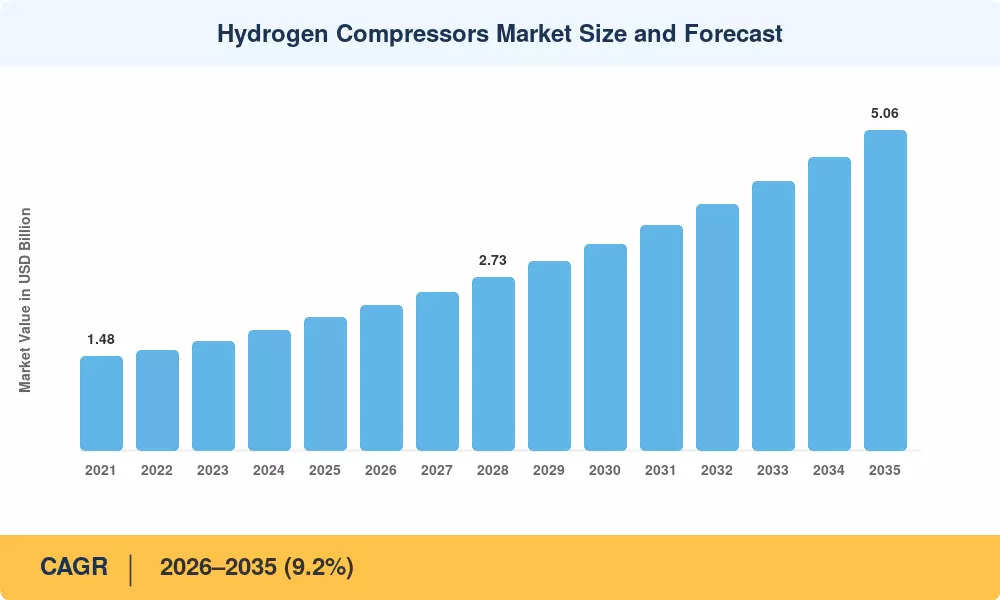
Hydrogen Compressors Market projected to reach USD 5.06 Billion, at a CAGR of 9.2% during 2026 to 2035
NEW YORK, NY, UNITED STATES, August 24, 2026 /EINPresswire.com/ — As Per the MRFR Analysis, Hydrogen Compressors Market projected to reach USD 5.06 Billion, at a CAGR of 9.2% during 2026 to 2035, driven by Growing demand for hydrogen fuel in transportation and energy sectors drives innovation in the Hydrogen Market.
Market Overview
The Hydrogen Compressors Market encompasses specialized equipment designed to pressurize hydrogen gas for various applications, including hydrogen fueling stations, industrial processing, pipeline transport, and power generation. These compressors are critical components in the hydrogen value chain, enabling efficient storage, transportation, and dispensing of hydrogen by raising its pressure from production levels to the high pressures required for end-use applications. The market serves a diverse range of end-users, including energy and power companies, transportation operators, chemical and petrochemical plants, and electronics manufacturers.
Two forces are accelerating this trajectory: government-backed hydrogen strategies now active in over 40 countries, and the rapid buildout of hydrogen refueling infrastructure driven by targets set under the U.S. Inflation Reduction Act and the EU’s REPowerEU plan [1][2]. Both programs commit tens of billions in subsidies that directly increase demand for compression equipment across the value chain. The U.S. Inflation Reduction Act allocates up to USD 3/kg in clean-hydrogen production tax credits under Section 45V, while the DOE’s USD 7 billion Regional Clean Hydrogen Hubs program directly funds compression infrastructure at seven hub sites across the country [1][8]. In Europe, the REPowerEU plan targets 10 million tonnes of domestic renewable hydrogen production by 2030, a goal that requires compressor capacity roughly four times current installed levels [2].
The Hydrogen Compressors Market is witnessing a significant technological transition. The long-standing mechanical piston systems that have served refinery hydrogen loops for decades are being replaced by purpose-built, oil-free diaphragm and ionic liquid structures that deliver fuel-cell-grade purity [3]. The Hydrogen Shot, set by the U.S. Department of Energy to achieve a delivered cost of hydrogen of USD 1/kg by 2031, puts immense pressure on compressor OEMs to lower lifespan energy use by 20-30% [3]. In 2024, the global investment in next-generation compressor R&D is estimated to be more than USD 450 million [4]. Reciprocating compressors currently hold the largest technology share at approximately 42% of 2025 revenue, driven by proven reliability in industrial hydrogen applications, while diaphragm compressors are the fastest-growing technology segment with a projected CAGR of 11.8% through 2035, reflecting surging demand for contaminant-free fuel-cell hydrogen [16].
North America holds the greatest share of the Hydrogen Compressors Market, accounting for over 34% of 2025 revenue, driven by California’s growing network of more than 100 retail hydrogen stations and federal clean-hydrogen production tax credits [5]. Asia-Pacific is the fastest-expanding market with a projected CAGR of 11.4% and is driven by national hydrogen roadmaps in Japan and South Korea. Europe retains the second greatest share with around 29%, headed by Germany’s H2Global mechanism and the Netherlands’ HyWay 27 pipeline conversion project [6]. The next decade will be favorable to compressor vendors that can handle both massive pipeline-injection systems and tiny fueling-station skids simultaneously.
Get Free Sample Report for Detailed Market Insights:
https://www.marketresearchfuture.com/sample_request/21961
Market Segmentation
By Compressor Type
The Hydrogen Compressors Market is segmented into Reciprocating, Diaphragm, Centrifugal, Ionic Liquid Piston, and Electrochemical compressors. Reciprocating compressors hold the largest technology share at approximately 42% of 2025 revenue, driven by proven reliability in refinery and station use [16]. Their mature supply chain and wide pressure-ratio flexibility make them the default choice for most greenfield hydrogen projects. Diaphragm compressors are the fastest-growing technology segment with a projected CAGR of 11.8% through 2035, reflecting surging demand for ultra-high-purity fuel-cell hydrogen [3]. Their hermetic seal design eliminates oil-contamination risk, a requirement for PEM fuel-cell vehicles that specify hydrogen purity of 99.97% or higher.
Ionic liquid piston technology represents the most disruptive segment, with a CAGR of 13.1% through 2035, reflecting early adoption at hydrogen refueling stations in Europe and North America [3]. Centrifugal compressors serve pipeline-injection and large-scale storage applications, while electrochemical compression technology is forecast to reach USD 0.48 billion by 2035, positioning it as the breakout category for distributed refueling with solid-state, silent operation [15].
By Application
The market serves Hydrogen Fueling Stations, Industrial Processing, Pipeline Transport, Power Generation, and Other applications (Electronics, Labs). Hydrogen fueling stations represent the single largest application, capturing an estimated 35% share in 2025, driven by government station mandates and subsidies [5][9]. Each station requires compression from approximately 20–30 bar (electrolyzer output) to 350 or 700 bar for vehicle dispensing, a process that demands reliable multi-stage compression with rapid cycle times.
Industrial gas processing contributes roughly USD 0.59 billion in 2025, anchored by refinery hydrocracking and ammonia synthesis operations [8]. Pipeline transport applications are expanding at a CAGR of 10.6% through 2035 as European and U.S. operators repurpose natural-gas trunk lines for hydrogen blending [6]. Power generation applications represent approximately 12% share in 2025, driven by gas-turbine hydrogen blending demonstrations.
By End User
The Hydrogen Compressors Market serves Energy & Power, Transportation, Chemical & Petrochemical, Electronics & Semiconductor, and Other end-users. The Energy & Power segment holds 32% share in 2025, driven by power-to-gas and grid-scale storage applications [8]. The Transportation segment is the fastest-growing buyer category with a CAGR of 11.9%, as fuel-cell passenger cars, buses, and heavy-duty trucks move from pilot fleets to commercial deployment. South Korea alone plans to put 200,000 fuel-cell vehicles on the road by 2030, each requiring access to 700-bar dispensing infrastructure that depends on compression equipment [9]. Chemical & Petrochemical represents approximately USD 0.46 billion in 2025, serving existing hydrogen-intensive processes.
By Region
North America leads the Hydrogen Compressors Market with approximately a 34% revenue share, underpinned by production tax credits and refinery conversion investments [1][8]. Europe accounts for roughly 29% of global demand, with Germany alone representing about 9% of the worldwide total [6]. Asia-Pacific delivers the highest growth rate at a CAGR of 11.4% through 2035, driven by national hydrogen roadmaps in Japan and South Korea [9]. South America and the Middle East & Africa represent smaller but strategically important markets with CAGRs of 9.8% and 8.3% respectively, leveraged by green hydrogen export strategies in Chile and Saudi Arabia’s NEOM project [20][21].
You can buy this market report at:
https://www.marketresearchfuture.com/checkout?currency=one_user-USD&report_id=21961
Regional Analysis
North America
North America commands the greatest share of the Hydrogen Compressors Market at approximately 34% of 2025 revenue, anchored by California’s growing network of more than 100 retail hydrogen stations and federal clean-hydrogen production tax credits [5]. The United States dominates regional revenue with approximately 82% share, driven by the Section 45V tax credits and DOE hydrogen hubs [1][8]. The seven regional clean-hydrogen hubs awarded USD 7 billion in federal funding each require dedicated compression and storage infrastructure, with California’s Low Carbon Fuel Standard and the 45V production tax credit combining to make hydrogen refueling projects financially viable [8]. Canada follows with a 10.1% CAGR through 2035, driven by Alberta’s blue-hydrogen strategy and export terminals, while Mexico represents a smaller but growing market serving industrial hydrogen demand in the petrochemical sector [17].
Europe
Europe holds roughly 29% of global Hydrogen Compressors Market demand, with Germany alone representing about 9% of the worldwide total [6]. Germany’s GET H2 pipeline and national hydrogen strategy account for approximately 31% of European revenue, spending heavily on both pipeline-scale centrifugal units and station-level reciprocating systems [6]. The Netherlands follows with a 10.8% CAGR, driven by the HyWay 27 pipeline conversion project [10]. France and the United Kingdom contribute approximately 14% and 12% of European revenue respectively, leveraging nuclear-to-hydrogen coupling and offshore wind-to-H2 integration [13]. The European Commission’s Hydrogen Bank, which held its first auction in late 2023 awarding EUR 720 million in subsidies, has created a pipeline of projects that will procure compression equipment through 2028 [2].
Asia-Pacific
Asia-Pacific is the fastest-growing region in the Hydrogen Compressors Market with a projected CAGR of 11.4% through 2035, driven by national hydrogen roadmaps in Japan and South Korea [9]. Japan accounts for approximately 28% of APAC revenue, with its METI allocating JPY 375 billion for hydrogen and ammonia supply-chain development through 2030 and targeting 1,000 hydrogen refueling stations by 2028 [9]. China holds the largest share at approximately 33% of APAC revenue, supported by fuel-cell vehicle subsidies and domestic OEM growth. South Korea follows with a 12.6% CAGR, driven by its Hydrogen Economy Promotion Act mandating 660 refueling stations by 2030 [9]. Australia contributes approximately 8% of APAC revenue through export-oriented green hydrogen hubs.
South America
South America represents approximately 5% of the Hydrogen Compressors Market, with Chile and Brazil emerging as key players. Chile accounts for approximately 42% of regional revenue, driven by its national green-hydrogen export strategy envisioning the country becoming a leading exporter by 2035 [20]. Brazil follows with a 9.8% CAGR, leveraging bioenergy-to-hydrogen integration, while Argentina’s Patagonia wind-hydrogen corridor represents a growing opportunity.
Middle East & Africa
The Middle East & Africa region is growing at a CAGR of 8.3% through 2035, driven by blue hydrogen and ammonia export projects. Saudi Arabia dominates with approximately 45% of regional revenue, anchored by the NEOM green-hydrogen project—a USD 8.4 billion joint venture that will require substantial compression capacity for hydrogen conversion and export logistics [21]. The UAE follows with a 9.4% CAGR, driven by Abu Dhabi blue-hydrogen exports, while South Africa’s platinum-valley hydrogen corridor contributes approximately 15% of regional revenue.
Competitive Landscape / Key Players
The Hydrogen Compressors Market is relatively consolidated, with the top five players projected to account for 38-45% of revenue share [14]. Key players include Burckhardt Compression, Howden (Chart Industries), PDC Machines, Neuman & Esser (NEA), Atlas Copco, Sundyne / HMD Kontro, Maximator Hydrogen, Hydro-Pac, HyET Hydrogen, and Mehrer Compression [14].
Burckhardt Compression leads with an estimated 8–11% revenue share, offering process-gas reciprocating and diaphragm systems as a full-service lifecycle partner with Swiss headquarters [16]. Howden (Chart Industries) follows with 7–10% share, providing reciprocating and centrifugal compressors with integrated station skids and a broad portfolio post-Chart merger [23]. PDC Machines holds 5–8% share as a U.S. market leader in station-grade diaphragm compressors. Neuman & Esser commands 5–7% share, specializing in high-pressure reciprocating and pipeline compression with strong German engineering. Atlas Copco holds 4–7% share, offering oil-free compressors with a global service footprint [14].
Strategic developments in the industry include Chart Industries completing integration of Howden’s compression division in June 2024, creating a combined hydrogen compression portfolio spanning station, pipeline, and industrial applications [23]. The European Commission awarded EUR 720 million in the inaugural European Hydrogen Bank auction in December 2023, funding 7 green-hydrogen projects that include compression procurement [2]. The U.S. DOE announced USD 7 billion in funding for seven Regional Clean Hydrogen Hubs in October 2023, each requiring dedicated compression and storage infrastructure [8].
Latest Industry News & Developments
Chart Industries / Howden (June 2024): Completed integration of Howden’s compression division, creating a combined hydrogen compression portfolio spanning station, pipeline, and industrial applications, strengthening the company’s position in the Hydrogen Compressors Market [23].
European Commission (December 2023): Awarded EUR 720 million in the inaugural European Hydrogen Bank auction, funding 7 green-hydrogen projects that include compression procurement [2].
U.S. DOE (October 2023): Announced USD 7 billion in funding for seven Regional Clean Hydrogen Hubs, each requiring dedicated compression and storage infrastructure, creating significant demand for compressor equipment across the Hydrogen Compressors Market [8].
Market Challenges & Opportunities
Challenges
The Hydrogen Compressors Market faces several notable challenges. High capital and energy costs represent a significant restraint, with a typical 700-bar multi-stage reciprocating compressor skid costing USD 400,000–800,000, and compression accounting for an estimated 10–15% of delivered hydrogen cost [15]. Electricity consumption during compression adds USD 0.30–0.50/kg to the cost of hydrogen, constraining deployment in price-sensitive markets until compressor efficiency improves [15].
Limited hydrogen-specific codes and standards slow permitting and increase project lead times, with ASME, ISO, and CEN developing hydrogen-specific pressure-equipment directives but full harmonization unlikely before 2028 [16]. Supply-chain bottlenecks for specialty alloys, including specialized stainless-steel and nickel alloys required to prevent hydrogen embrittlement, tightened in 2023–2024 as demand from electrolyzer, nuclear, and aerospace sectors competed for the same material grades [17]. Gray hydrogen price competitiveness and skilled-workforce shortages further challenge market growth.
Opportunities
Significant opportunities exist in the Hydrogen Compressors Market. Distributed hydrogen production and micro-compression, with on-site electrolysis paired with compact compressor packages, offers a path to decentralized refueling that bypasses expensive tube-trailer logistics [19]. Compressor-as-a-service business models, leasing and performance-based contracts, allow station operators to avoid large upfront capital outlays, with OEMs bundling remote monitoring, predictive maintenance, and guaranteed uptime into subscription models [15].
Emerging-market hydrogen corridors in India (USD 2.3 billion National Green Hydrogen Mission) and Chile (25 GW of electrolysis capacity by 2030) present greenfield opportunities for suppliers willing to localize manufacturing and service [19][20]. Offshore wind-to-hydrogen integration in Northern Europe demands corrosion-resistant, high-reliability compressor designs that command premium pricing [13]. Data-driven compressor fleet optimization, including digital twins, vibration analytics, and AI-based load scheduling, can increase compressor availability from the industry average of 92% toward 97%, cutting station downtime and fuel-delivery costs [7].
To explore more market insights, visit us at:
https://www.marketresearchfuture.com/reports/hydrogen-compressors-market-21961
Final Market Summary
The Hydrogen Compressors Market is poised for robust growth, projected to expand from USD 2.29 billion in 2026 to USD 5.06 billion by 2035, at a CAGR of 9.2%. This expansion is fundamentally underpinned by growing demand for hydrogen fuel in transportation and energy sectors, government hydrogen strategies and subsidies, and the rapid buildout of hydrogen refueling infrastructure. North America maintains its dominant position, driven by the Inflation Reduction Act’s tax credits and the DOE’s Hydrogen Hubs program, while Asia-Pacific emerges as the fastest-growing region, propelled by national hydrogen roadmaps in Japan, South Korea, and China. Technological innovation, including diaphragm and ionic liquid piston compressors, is reshaping the competitive landscape, enabling operators to achieve fuel-cell-grade purity and reduce energy consumption. The market’s long-term potential remains exceptionally strong, supported by the convergence of decarbonization policy, electrolyzer scale-up, and emerging opportunities in distributed hydrogen production and compressor-as-a-service business models, ensuring hydrogen compression equipment’s critical role in the global hydrogen economy through 2035 and beyond.
More Related Reports from MRFR Library:
Solar Inverter Market: https://www.marketresearchfuture.com/reports/solar-inverter-market-4071
Motor Control Centers Market: https://www.marketresearchfuture.com/reports/motor-control-centers-market-4105
Solar Rooftop Market: https://www.marketresearchfuture.com/reports/solar-rooftop-sales-market-4174
Solar Charge Controllers Market: https://www.marketresearchfuture.com/reports/solar-charge-controllers-market-4280
Subsea System Market: https://www.marketresearchfuture.com/reports/subsea-system-market-4448
Smart Meters Market: https://www.marketresearchfuture.com/reports/smart-meters-market-4569
Solar PV Mounting Systems Market: https://www.marketresearchfuture.com/reports/solar-pv-mounting-systems-market-4619
Lead Acid Battery Market: https://www.marketresearchfuture.com/reports/lead-acid-battery-market-5055
Marine Hybrid Propulsion System Market: https://www.marketresearchfuture.com/reports/marine-hybrid-propulsion-system-market-5261
Digital Substation Market: https://www.marketresearchfuture.com/reports/digital-substation-market-5363
Larry Wilson
WantStats Research And Media Pvt. Ltd.
+ +1 855-661-4441
email us here
Visit us on social media:
LinkedIn
Facebook
YouTube
X
Legal Disclaimer:
EIN Presswire provides this news content “as is” without warranty of any kind. We do not accept any responsibility or liability
for the accuracy, content, images, videos, licenses, completeness, legality, or reliability of the information contained in this
article. If you have any complaints or copyright issues related to this article, kindly contact the author above.

Media gallery