Infotainment and connectivity chips reached USD 10.48 bn in 2025 as cockpit-domain controllers consolidated display, audio, and 5G telematics onto single SoCs.
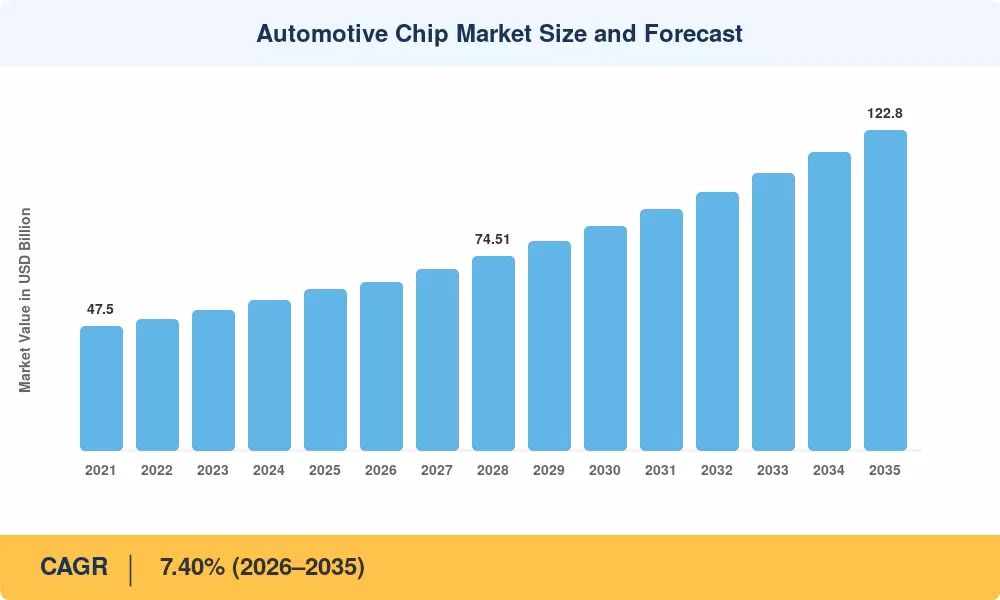
NEW YORK, NY, UNITED STATES, August 27, 2026 /EINPresswire.com/ — According to Market Research Future, the Automotive Chip Market is projected to rise from USD 64.60 billion in 2026 to USD 122.80 billion by 2035, registering a 7.40% CAGR during the forecast period 2026 – 2035. This substantial growth reflects the increasing electronic content in modern vehicles, where semiconductors have become foundational components enabling everything from powertrain control and safety systems to infotainment and autonomous driving capabilities. The automotive chip market is growing significantly faster than the broader automotive market as vehicles transition toward software-defined, connected, and electrified platforms.
Market Overview
Automotive chips, also known as automotive semiconductors, are specialized integrated circuits designed to withstand the demanding operating conditions of vehicles, including extreme temperatures, vibration, and electromagnetic interference. These components encompass a wide range of devices including microcontrollers and microprocessors, memory ICs, analog ICs, logic ICs, discrete power devices, and sensors that collectively enable the electronic systems powering modern vehicles. The market is experiencing robust expansion as vehicles increasingly incorporate advanced driver assistance systems, electric powertrains, connected services, and sophisticated infotainment platforms. Silicon remains the dominant semiconductor material, accounting for a substantial share of market revenue, while wide-bandgap materials like Silicon Carbide and Gallium Nitride are gaining traction in power electronics applications.
The key growth drivers propelling this market expansion include the rising demand for advanced driver assistance systems and autonomous driving technologies, which require high-performance processors and sensor integration. The increasing adoption of electric vehicles is fueling demand for power semiconductors, battery management chips, and energy-efficient processors. The growing use of infotainment systems and connected vehicle services is expanding the market for microcontrollers, memory chips, and connectivity solutions. The integration of vehicle-to-everything communication and 5G connectivity further reinforces the need for sophisticated semiconductor platforms capable of handling high data throughput and low-latency communication.
Technological developments are reshaping the automotive chip landscape at an accelerating pace. The industry is witnessing a shift toward centralized compute architectures, where domain controllers and system-on-chip platforms replace distributed electronic control units. The adoption of advanced fabrication nodes, including 10–22 nm and sub-10 nm processes, enables higher performance, lower power consumption, and increased integration. Chiplet-based designs are emerging as a strategy to enhance supply security and enable modular innovation. The increasing importance of functional safety and cybersecurity is driving investment in validated software stacks and secure hardware designs. The Automotive Semiconductor Market continues to evolve alongside broader industry trends toward electrification and automation.
Policy and regulatory frameworks are playing a transformative role in shaping market dynamics. Government initiatives to strengthen domestic semiconductor manufacturing are reshaping global supply chains. The CHIPS Act in the United States, the European Chips Act, and similar programs in Asia are driving investment in local production capacity and R&D. Regulatory mandates regarding vehicle safety, emissions, and connectivity are accelerating the adoption of electronic systems that require advanced semiconductor solutions. Trade policies and export controls are influencing supply chain strategies and prompting investment in supply chain resilience and localization.
The demand outlook for automotive chips remains exceptionally strong, driven by the increasing semiconductor content per vehicle. Modern vehicles contain thousands of chips, with electric vehicles and highly automated vehicles requiring significantly higher semiconductor value than conventional internal combustion engine vehicles. The transition toward software-defined vehicles further amplifies demand, as continuous feature updates and service delivery require robust computing platforms and memory solutions. The Automotive Microcontrollers Market represents a substantial portion of the overall automotive chip ecosystem, with microcontrollers serving as the brains behind countless vehicle functions from engine control to body electronics and safety systems. As vehicle architectures become more centralized, the demand for high-performance microcontrollers and processors continues to grow.
📍 Get Free Sample Report for Detailed Market Insights:
https://www.marketresearchfuture.com/sample_request/7676
Market Segmentation
The automotive chip market is segmented based on component, fabrication node, semiconductor material, propulsion type, vehicle class, application domain, and end-market to provide comprehensive insights into the industry landscape.
By Component: The market is categorized into Microcontrollers & Microprocessors, Memory ICs, Analog ICs, Logic ICs, Discrete Power Devices, and Sensors. Microcontrollers and microprocessors dominate the market, serving as the processing backbone for powertrain control, ADAS, infotainment, and body electronics. Memory ICs are growing in importance as software-defined vehicles require increasing data storage and fast access capabilities. Analog ICs play a crucial role in power management, signal conditioning, and sensor interfacing. Discrete power devices, including IGBTs, MOSFETs, and wide-bandgap semiconductors, are essential for electric vehicle power electronics and charging systems. Sensors, including image sensors, LiDAR, radar, and MEMS, are experiencing rapid growth driven by ADAS and autonomous driving applications.
By Fabrication Node: The market is segmented into 23–45 nm, > 45 nm, 10–22 nm, and ≤ 10 nm nodes. The 10–22 nm segment is growing rapidly as ADAS, autonomous driving, and infotainment applications demand higher performance and lower power consumption. Leading-edge nodes, including sub-10 nm processes, are being adopted for advanced compute platforms, with TSMC and Samsung maintaining substantial control over sub-16nm automotive node capacity. Mature nodes above 45 nm continue to serve power management and sensor applications where cost and reliability are prioritized over performance.
By Semiconductor Material: The market covers Silicon, Silicon Carbide, Gallium Nitride, and Others. Silicon remains the predominant material, with a substantial revenue share, offering unmatched cost per transistor across microcontrollers, memory, and network ICs. Silicon Carbide is entrenched in traction inverters, particularly in 800-volt architectures where it reduces conduction losses compared to silicon IGBTs. Gallium Nitride is forecast to experience robust growth in on-board chargers, enabling higher efficiency and smaller passive components.
By Propulsion Type: The market serves BEV, ICE, HEV/PHEV, and FCEV vehicles. Battery electric vehicles represent the fastest-growing propulsion segment, requiring extensive semiconductor content for battery management, traction inverters, and thermal management. Hybrid and plug-in hybrid vehicles require both power electronics and internal combustion engine control systems, creating diverse semiconductor demand.
By Vehicle Class: The market is divided into Passenger Cars, Light Commercial Vehicles, and Heavy Commercial Vehicles. Passenger cars dominate the market, driven by high production volumes and increasing consumer demand for safety, connectivity, and comfort features. Commercial vehicles represent a growing segment as telematics, fleet management, and electric commercial vehicle adoption expand.
By Application Domain: The market is segmented into ADAS & Safety, Powertrain & Chassis, Body Electronics & Comfort, Infotainment & Connectivity, and Telematics. Telematics and infotainment applications account for a significant market share, driven by consumer demand for digital connectivity, navigation systems, and multimedia experiences. ADAS and safety applications are growing rapidly as regulatory mandates and consumer demand for safety features increase. Powertrain and chassis applications require reliable, high-performance chips for engine control, transmission control, and chassis management.
By End-Market: The market covers OEM-Installed and Aftermarket channels. OEM-installed applications dominate as vehicle manufacturers integrate increasing electronic content during production. The aftermarket segment serves replacement parts, retrofits, and upgrades, providing opportunities for component suppliers.
🛒 You can buy this market report at:
https://www.marketresearchfuture.com/checkout?currency=one_user-USD&report_id=7676
Regional Analysis
Asia Pacific represents the dominant and fastest-growing regional market, accounting for a substantial share of global automotive chip revenue. China leads the region with the world’s largest vehicle market and aggressive new energy vehicle policies, creating robust demand for automotive semiconductors across all categories. Domestic manufacturers are integrating home-grown microcontrollers to enhance supply chain security. Japan and South Korea are nurturing advanced semiconductor research, positioning themselves to capture next-generation centralized compute sockets. India trails in per-vehicle semiconductor spend but is investing through electronics manufacturing incentives to expand assembly capacity. The region’s growth is further supported by the rapid adoption of electric and connected vehicles, with China requiring that a significant portion of new cars be electric or plug-in hybrid by 2035.
North America represents a mature and strategically important market, supported by substantial semiconductor manufacturing investments under the CHIPS program. United States automakers favor domestically sourced microcontrollers to de-risk supply lines following historical shortages. The region benefits from strong collaboration between automotive OEMs and semiconductor companies focused on improving supply chain resilience and local chip manufacturing capacity. Government incentives supporting domestic semiconductor production and electric vehicle expansion continue to strengthen regional market dynamics. Canada contributes through its zero-emission vehicle infrastructure program and growing automotive electronics ecosystem.
Europe accounts for a significant market share, driven by strong automotive engineering capabilities, increasing electric vehicle adoption, and advanced automotive safety regulations. European automakers are heavily investing in autonomous driving systems, digital cockpit technologies, and electric mobility platforms that require sophisticated semiconductor integration. The region maintains the highest semiconductor spend per vehicle globally, driven by regulatory timetables accelerating BEV and ADAS deployment. Germany, France, and the United Kingdom remain key centers for automotive innovation and semiconductor deployment. The European Chips Act is supporting investment in semiconductor R&D and production capacity, including Infineon’s Dresden expansion and STMicroelectronics’ silicon-carbide push.
South America and the Middle East and Africa represent emerging markets with developing potential. Brazil is showing moderate growth through its Rota 2030 fuel-efficiency target, adding microcontroller value to flex-fuel drivetrains. The Middle East, particularly Saudi Arabia and the UAE, is demonstrating growing momentum through public-private EV investments and smart city initiatives, while African markets are at varying stages with South Africa leading the region .
Competitive Landscape and Key Players
The automotive chip market is highly competitive, featuring a mix of established semiconductor manufacturers, automotive suppliers, and emerging players. The competitive landscape is characterized by technological innovation, strategic partnerships, and supply chain investments.
Key players operating in this market include Infineon Technologies AG, NXP Semiconductors, Renesas Electronics Corporation, STMicroelectronics, Robert Bosch GmbH, Microchip Technology, Texas Instruments, Broadcom Inc., MediaTek Inc., and ON Semiconductor. Infineon leads globally with substantial automotive revenue, followed closely by NXP and STMicroelectronics.
Strategic developments are reshaping the competitive landscape. Platform and SoC vendors are differentiating through investments in heterogeneous compute, on-chip security, and validated software stacks that reduce OEM integration risk. Partnerships between chip suppliers and software orchestration providers have become more common, enabling faster time-to-market for complex ADAS and infotainment systems. Established automotive suppliers are consolidating relationships with semiconductor vendors to co-develop reference platforms and streamline certification pathways.
Innovation and technology initiatives are accelerating across the industry. Companies are developing modular design practices, diversifying validated suppliers, and investing in secure update ecosystems to capture value in the rapidly evolving market. The integration of AI capabilities, functional safety features, and cybersecurity measures are becoming competitive differentiators. OEMs, including Tesla, BYD, and Nio, are accelerating vertical integration, disrupting traditional supply chains, and reshaping how value is captured across the ecosystem.
Latest Industry News and Developments
Recent industry developments highlight the dynamic nature of the automotive chip market. The global competitive landscape is shifting as US and European players continue to leverage scale, IP depth, and established OEM relationships to defend leadership, while Chinese companies, fueled by national support, are aggressively building capabilities to secure a self-sufficient semiconductor ecosystem. Domestic manufacturers such as BYD and NIO are integrating home-grown microcontrollers to sidestep export controls, a shift that lifts regional dollar content.
Supply chain investments continue to reshape the market. The CHIPS program in the United States and the European Chips Act represent significant commitments to strengthening domestic semiconductor manufacturing capacity. TSMC and Samsung maintain substantial control over sub-16nm automotive nodes, with capacity fully allocated through 2027, creating opportunities and challenges for chip suppliers.
Technology demonstration and standardization efforts continue to advance. Chiplet-based designs are emerging as a strategy to enhance supply security and innovation while enabling modular system development. The increasing centrality of sensors, connectivity, and compute requires suppliers to offer validated, secure platforms that reduce integration risk for OEMs.
Market Challenges and Opportunities
The automotive chip market faces several key challenges that could impact growth trajectories. Global supply shortages and supply-chain disruptions have severely affected automotive production, leading to delays and increased costs. The increased expenses linked to the development of sophisticated automotive processors restrict smaller manufacturers’ access to the market. Geopolitical risks, AI-driven compute requirements, and the architectural shift toward centralized vehicle platforms continue to test the resilience of the entire supply chain. Variance in regulatory regimes across countries complicates global rollouts and product strategies.
Emerging opportunities are abundant in the evolving mobility landscape. The accelerating adoption of electric and autonomous vehicles creates significant opportunities for innovative semiconductor solutions. The shift toward software-defined vehicles offers potential for chip suppliers to deliver differentiated connectivity experiences through software enhancements and over-the-air updates. The integration of automotive chips with broader mobility ecosystems, including connected vehicle platforms, telematics, and smart city infrastructure, creates comprehensive solutions that serve diverse customer needs.
Technology-driven possibilities are expanding rapidly with advancements in AI, machine learning, and edge computing. Investments in heterogeneous compute, on-chip security, and validated software stacks that reduce OEM integration risk are becoming critical success factors. The development of advanced fabrication nodes and packaging technologies enables higher performance and integration.
Future growth potential remains strong, driven by the ongoing digitalization of vehicles and the increasing importance of semiconductors in enabling safety, connectivity, and autonomy. Organizations that combine hardware excellence with robust software ecosystems will be best positioned to retain value as vehicle functions become more software-defined and updateable. Strategic partnerships, investments in automotive-grade validation, and engagement with regulatory processes will accelerate adoption and unlock new service-based revenue models.
To explore more market insights, visit us at:
https://www.marketresearchfuture.com/reports/automotive-chip-market-7676
Final Market Summary
Key factors expected to influence future development include the pace of EV adoption, advancements in fabrication technologies, and the evolution of software-defined vehicle platforms. The development of resilient supply chains and diversified sourcing strategies will address availability concerns and accelerate market growth. Investments in secure, validated platforms that support continuous updates and feature enhancements will enable manufacturers to meet the evolving demands of connected and automated vehicles.
The transformation from simple electronic components to sophisticated, software-enabled semiconductor platforms represents a fundamental industry evolution, positioning automotive chips as essential components of the sustainable mobility ecosystem. As vehicles become increasingly connected, autonomous, and software-defined, the role of automotive chips will continue to expand, ensuring sustained innovation and growth throughout the forecast period and beyond.
More Related Reports from MRFR Library:
Automotive Roof System Market : https://www.marketresearchfuture.com/reports/automotive-roof-system-market-34666
Automotive Parts and Components Market : https://www.marketresearchfuture.com/reports/automotive-parts-components-market-34690
Industrial Tire Market : https://www.marketresearchfuture.com/reports/industrial-tire-market-34760
Automotive Maintenance Tool Market : https://www.marketresearchfuture.com/reports/automotive-maintenance-tool-market-34861
Automotive Mosfet Market : https://www.marketresearchfuture.com/reports/automotive-mosfet-market-34893
Automotive Throttle Body Market : https://www.marketresearchfuture.com/reports/automotive-throttle-body-market-34928
Automotive MRO Market : https://www.marketresearchfuture.com/reports/automotive-mro-market-35095
Automotive Engine Air Filter Market : https://www.marketresearchfuture.com/reports/automotive-engine-air-filter-market-35197
Commercial Vehicles Tire Market : https://www.marketresearchfuture.com/reports/commercial-vehicles-tire-market-35226
Commonwealth of Independent States Underground Mining Equipment Market : https://www.marketresearchfuture.com/reports/commonwealth-of-
independent-states-underground-mining-equipment-market-3523
Market Research Future
Market Research Future
+1 855-661-4441
email us here
Legal Disclaimer:
EIN Presswire provides this news content “as is” without warranty of any kind. We do not accept any responsibility or liability
for the accuracy, content, images, videos, licenses, completeness, legality, or reliability of the information contained in this
article. If you have any complaints or copyright issues related to this article, kindly contact the author above.

Media gallery