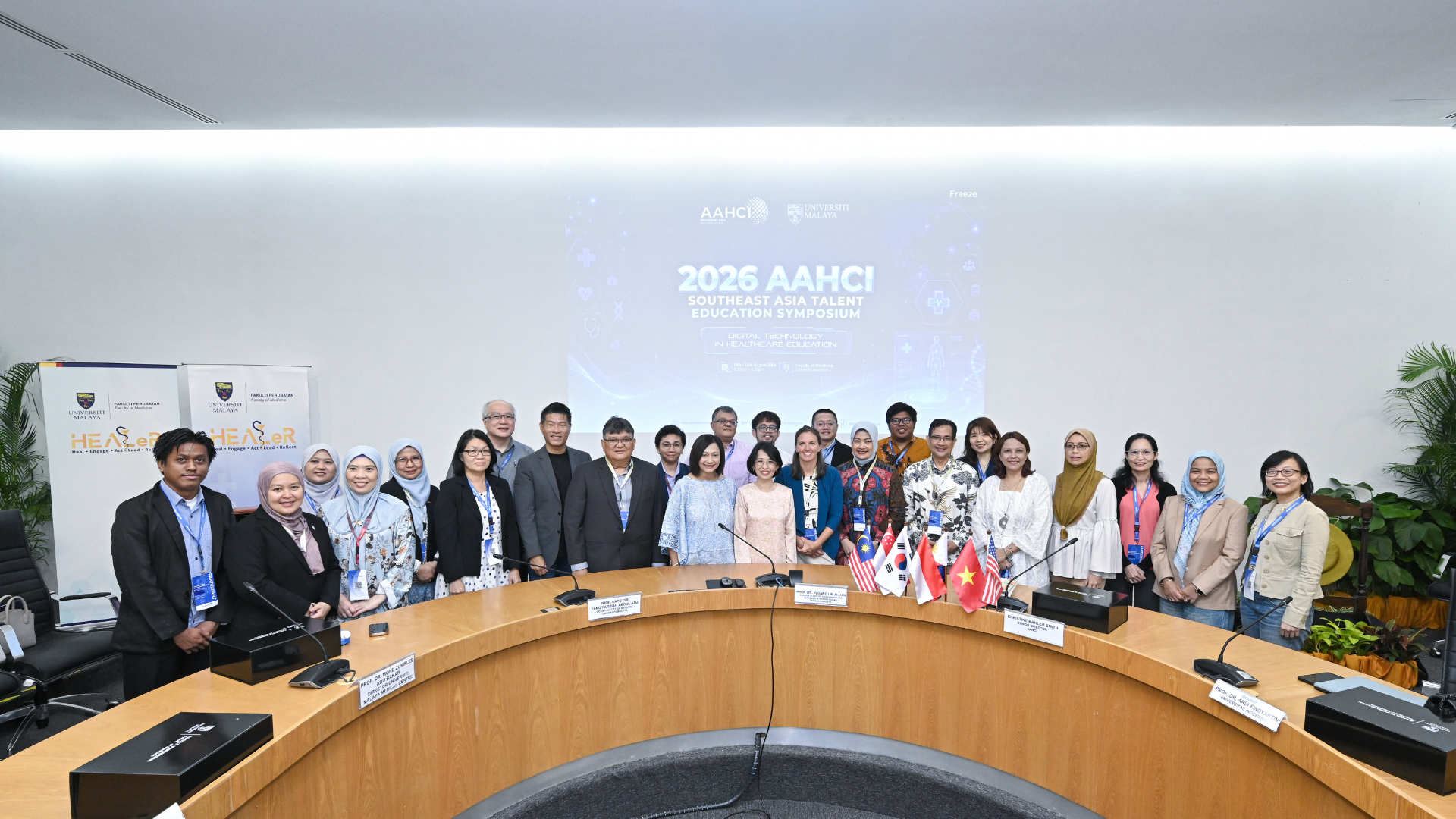
At Universiti Malaya, Zen used rehabilitation robotics to show that personalised care needs the right technology, matched to patients and clinical judgement.
KUALA LUMPUR, MALAYSIA, September 3, 2026 /EINPresswire.com/ — Zen Koh, scientific advisor to Robotimize Group and founder and CEO of MotusAcademy, joined healthcare leaders, clinicians and academics at the 2026 AAHCI Southeast Asia Talent Education Symposium, held Aug. 15–16 at Universiti Malaya in Kuala Lumpur. Held under the theme “Digital Technology in Healthcare Education,” the symposium explored how artificial intelligence, digital technologies and new models of care are reshaping healthcare education and the future workforce. Zen Koh participated in Forum 1: Personalised Healthcare, contributing a technology and industry perspective to discussions on smart and connected healthcare, health ecosystems and virtual care.
Zen Koh used rehabilitation robotics to illustrate a broader challenge facing personalised healthcare: technological capability does not automatically translate into clinical value. Modern rehabilitation systems can measure force, movement, speed, repetitions and the amount of assistance provided to a patient. But Zen Koh argued that collecting more data is only useful when clinicians can interpret it in the context of what an individual patient is trying to achieve.
“In rehabilitation, less assistance is sometimes more,” said Zen Koh. “The important question is not how much help the technology is capable of giving, but how much help this particular patient needs at this particular moment.”
The principle is often described in rehabilitation robotics as assistance-as-needed: providing enough support for patients to complete meaningful movement while encouraging them to contribute as actively as possible. Research increasingly supports approaches that preserve active participation during robot-assisted rehabilitation, while the evidence also highlights the need for continued clinical evaluation of different control strategies and patient populations.
For Koh, the same principle has implications far beyond rehabilitation robotics.
As artificial intelligence becomes more capable, healthcare professionals will increasingly need to develop what he described as calibrated trust — understanding when technology can be relied upon, when its recommendations should be questioned and when human judgement should override the system. That changes the educational challenge as well. Future healthcare professionals will need more than technical proficiency with AI-enabled tools. They will need the ability to understand their limitations, interpret data in context and remain accountable for decisions affecting patients.
Zen Koh also highlighted the gap between technological innovation and health-system adoption. While the visible innovation may be a robot, AI system or digital platform, successful implementation depends on a wider infrastructure that includes clinical protocols, staff training, maintenance, cybersecurity, technical support, software updates and outcome measurement.
“Technology can often be replicated much faster than clinical capability can be built,” Zen Koh said. “A successful pilot is not the same thing as sustainable adoption. The question is whether the people, workflows and support systems around the technology can make it work reliably in everyday care.”
That challenge is particularly important as healthcare becomes more continuous and extends beyond hospitals into rehabilitation centres, community services and the home. Measures such as range of motion, gait speed or treatment repetitions can describe part of a patient’s recovery, Zen Koh noted, but may not capture whether the person has regained the ability to work, prepare a meal, move independently or participate in family life. The implication is that personalisation should begin with the patient’s goals and use technology to support those goals — rather than allowing what a system happens to measure to define success.
For Robotimize Group, the discussion aligns with its approach to rehabilitation technology and clinical partnerships, which places emphasis on clinician-led deployment, training and ongoing implementation alongside the underlying technology.
“Technology only creates value when clinicians can use it safely, confidently and consistently,” said Kerry Guo, founder and CEO of Robotimize Group. “The device matters, but so do clinical judgement, workflow, training and long-term support.”
Zen Koh said the continuing evolution of robotics, sensing and artificial intelligence will allow healthcare systems to measure and respond to patients with increasing precision, but that technological sophistication should ultimately serve a human objective. “Data can travel at network speed. Recovery cannot. The more capable our technology becomes, the more important it is that we remain clear about who is making the decisions, what outcome matters to the patient and why.”
About Robotimize Group
Robotimize Group is a health technology company headquartered in Singapore, specialising in intelligent rehabilitation robotics and digital neurotechnologies. Through VivantePlexus™, its integrated rehabilitation technology ecosystem, and ACE™, its strategic partnerships portfolio, Robotimize develops and distributes technologies designed to support clinician-led rehabilitation, functional training, and technology-enabled care pathways across institutional and community settings. Product availability, indications, and use are subject to applicable regulatory approvals and local clinical requirements.
For more information, visit: http://www.robotimize.tech
Jerry HONG
Robotimize Group
+60 11-1224 1674
email us here
Legal Disclaimer:
EIN Presswire provides this news content “as is” without warranty of any kind. We do not accept any responsibility or liability
for the accuracy, content, images, videos, licenses, completeness, legality, or reliability of the information contained in this
article. If you have any complaints or copyright issues related to this article, kindly contact the author above.

Media gallery