The Business Research Company’s Stationary Fuel Cell Systems Global Market Report 2026 – Market Size, Trends, And Forecast 2026-2035
LONDON, GREATER LONDON, UNITED KINGDOM, October 23, 2026 /EINPresswire.com/ — The stationary fuel cell systems market has been rapidly expanding, reflecting a growing global shift toward cleaner and more efficient energy solutions. As industries and governments increasingly prioritize sustainable power sources, this market is positioned for significant growth in the coming years. Let’s explore the current market size, key growth drivers, regional trends, and the fundamental factors influencing this sector.
Current Market Size and Growth Outlook for Stationary Fuel Cell Systems
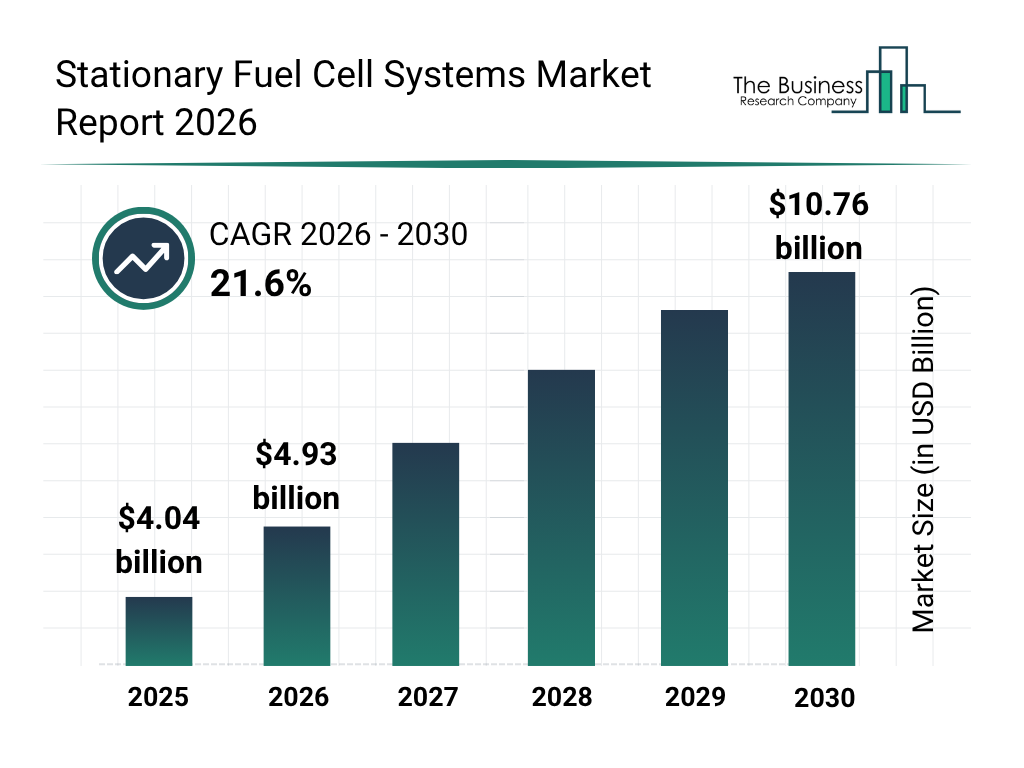
The stationary fuel cell systems market has experienced remarkable growth recently, with its value expected to rise from $4.04 billion in 2025 to $4.93 billion in 2026. This corresponds to a compound annual growth rate (CAGR) of 22.0%. The surge during this period is largely due to heightened demand for clean energy technologies, increased concerns about greenhouse gas emissions, broader adoption of distributed power generation, greater investments in hydrogen infrastructure, and an expanding need for dependable backup power supply.
Download a free sample of the stationary fuel cell systems market report:
https://www.thebusinessresearchcompany.com/sample_request?id=76915918&type=smp&name=Stationary%20Fuel%20Cell%20Systems%20Market%20Report%202026&utm_source=EINPresswire&utm_medium=Paid&utm_campaign=Oct_PR
Looking ahead, the market is predicted to grow even more substantially, reaching $10.76 billion by 2030 with a CAGR of 21.6%. Drivers of this future expansion include the accelerating deployment of hydrogen production and storage facilities, rising commercial demand for sustainable energy, growing use of fuel cells to stabilize power grids, increased application of stationary power systems in remote locations, and higher investment in renewable energy integration. Key trends shaping this growth encompass a stronger preference for hydrogen-based clean energy generation, rising demand for reliable distributed power solutions, increasing interest in low-emission alternatives to traditional generators, greater incorporation of fuel cells within decentralized energy systems, and a focus on long-duration backup power capabilities.
Understanding Stationary Fuel Cell Systems and Their Applications
Stationary fuel cell systems generate electricity through electrochemical reactions, typically using hydrogen as fuel, and operate at fixed sites. These systems provide continuous or backup power for applications such as commercial buildings, industrial plants, and grid support. Compared to conventional combustion generators, stationary fuel cells offer higher efficiency and produce far fewer emissions, making them an attractive option for sustainable energy production.
View the full stationary fuel cell systems market report:
https://www.thebusinessresearchcompany.com/report/stationary-fuel-cell-systems-market-report?utm_source=EINPresswire&utm_medium=Paid&utm_campaign=Oct_PR
The Growing Importance of Clean Energy Demand in Driving Market Expansion
One of the primary forces behind the growth of the stationary fuel cell systems market is the mounting demand for clean energy alternatives. Clean energy refers to technologies that generate or manage power with minimal environmental impact, often utilizing renewable or low-emission sources like solar, wind, hydrogen, and fuel cells. Concerns over climate change and greenhouse gas emissions are motivating governments, industries, and consumers to transition away from fossil fuels toward more sustainable energy options.
Stationary fuel cell systems fit into this shift by converting hydrogen into electricity efficiently and without direct greenhouse gas emissions, supporting efforts to decarbonize power generation. For example, in March 2024, the International Energy Agency (IEA) reported that the expansion of clean energy has played a key role in limiting the rise of global emissions, which grew by only 1.1% in 2023. This growing emphasis on clean energy solutions is a significant factor propelling the stationary fuel cell systems market forward.
Regional Market Dynamics for Stationary Fuel Cell Systems
In 2025, Asia-Pacific held the largest share of the stationary fuel cell systems market, reflecting the region’s rapid industrialization and energy transition initiatives. Meanwhile, the Middle East is projected to be the fastest-growing market throughout the forecast period. Other important regions covered in the market analysis include South East Asia, Western Europe, Eastern Europe, North America, South America, and Africa, providing a comprehensive global perspective on market trends and opportunities.
New additions to our 2026 reports:
• Market attractiveness scoring and analysis
• Total addressable market (TAM) analysis
• Company scoring matrix graphics and tables
• Excel-based forecasting dashboards
• Market hotspots infographics
• Key technologies and future trend analysis
• Updated graphics and tables
Speak With Our Expert:
Saumya Sahay
Americas +1 310-496-7795
Asia +44 7882 955267 & +91 8897263534
Europe +44 7882 955267
Email: marketing@tbrc.info
The Business Research Company – www.thebusinessresearchcompany.com
Follow Us On:
• LinkedIn: https://in.linkedin.com/company/the-business-research-company
Oliver Guirdham
The Business Research Company
+44 7882 955267
Visit us on social media:
LinkedIn
Facebook
X
Legal Disclaimer:
EIN Presswire provides this news content “as is” without warranty of any kind. We do not accept any responsibility or liability
for the accuracy, content, images, videos, licenses, completeness, legality, or reliability of the information contained in this
article. If you have any complaints or copyright issues related to this article, kindly contact the author above.

Media gallery